
Are bank debit orders still the safest way to pay monthly bills?
Are bank debit orders still the safest way to pay monthly bills? For many South Africans, yes, they’re still the most practical option, but not the safest in every case. DebiCheck has tightened authorisation at setup, yet cards and manual EFTs can be easier to control or stop quickly, depending on how predictable the bill is and how closely you watch your account.
Key takeaways
- DebiCheck adds bank-side approval at setup, which makes a debit order harder to fake than a legacy mandate.
- Debit orders work best for fixed monthly bills, while manual EFTs give full control over each payment.
- A card can be easier to freeze quickly than a debit order if you need to block future charges fast.
- If a collection is wrong, act through your bank as soon as possible, because timing affects your chances of reversal.
- Choose the payment method that fits the bill’s predictability, not just the lowest monthly admin.
How debit orders work in South Africa
A debit order is a payment instruction you authorise so a business can collect money from your bank account on agreed dates. In South Africa, that authorisation is called a debit order mandate, and it can be given in writing, by voice or electronically. Under PASA’s system, the service provider sends the collection instruction to your bank, which is why the quality of the mandate matters so much in practice Payment Association of South Africa (PASA).
The key difference is this: legacy EFT debit orders rely on the mandate and the bank’s processing rules, while DebiCheck requires the customer to approve the mandate electronically with the bank at the start of the contract. PASA says DebiCheck is a once-off approval with the bank, so the collection setup is tighter than an old-style registered mandate that may have been agreed outside the bank channel Payment Association of South Africa (PASA).
That upfront confirmation is the point. With DebiCheck, the bank verifies the mandate at the beginning, before the first collection is presented, which gives the payer more control over who can collect and on what terms.
With many legacy EFT debit orders, the merchant sends the debit instruction to the bank, but the bank does not verify each collection in the same way it does for DebiCheck, so the account holder has to rely more on the original mandate and later account monitoring Payment Association of South Africa (PASA).
This matters because debit order abuse in South Africa has been a real problem, both from invalid collections and from consumers unfairly disputing valid ones. PASA introduced DebiCheck to reduce that abuse, not to make debit orders flashy or new, but to make the first authorisation harder to fake and easier to prove later Payment Association of South Africa (PASA).
Debit orders versus cards and EFT for monthly bills
| Payment method | How authorisation works | Control over timing and amount | Fraud and dispute exposure | Best use case |
|---|---|---|---|---|
| Debit orders | The customer signs a mandate, and DebiCheck adds bank-side electronic approval at setup. | Low day-to-day control, because the merchant initiates collection on the agreed date; best when the amount is fixed or contract-based. | Higher risk on legacy EFT debit orders if the mandate is weak or the collection is disputed; DebiCheck improves proof of authorisation. | Fixed monthly bills, premiums and service contracts where the payer wants automatic collection. |
| Recurring card payments | The cardholder gives the merchant permission to charge the card again, usually for a subscription or membership. | Moderate control, because card limits, card freezes and replacement cards can interrupt charges quickly. | Chargebacks and card fraud processes can help, but the customer must notice the problem and act. | Subscriptions where the bill is predictable and the payer wants a fast way to block future charges. |
| Manual EFTs | The payer sends each payment themselves from banking app, internet banking or branch. | High control over amount and timing, because nothing leaves the account until the payer initiates it. | Lower exposure to unauthorised pulls, but higher risk of missed payments, late fees and human error. | Bills that change often, one-off payments and cases where the payer wants to approve every transfer. |
The safest option depends on the bill you’re paying, not on the payment rail alone. Debit orders are usually strongest for fixed bills such as insurance, gym memberships or school fees, because they reduce missed payments and cut down monthly admin. Manual EFTs suit bills that change from month to month, while recurring card payments are often better for subscriptions you may want to cancel quickly but still want to keep on automatic payment.
The practical trade-off is pretty straightforward. If the debit is for a gym, insurance premium or other regular service with a stable amount, a properly authorised debit order is efficient and easy to reconcile. If the bill varies, or you’ve had disputed collections before, a manual EFT or a card charge that can be frozen in your banking app may give you better day-to-day control.
For South African customers, the real question is not whether one method is perfect. It’s whether the payment method matches the risk of the bill. A household account that must never be missed usually benefits from automation, while a variable service charge is safer when you keep the last word on each payment.
How to dispute, stop, or cancel a debit order
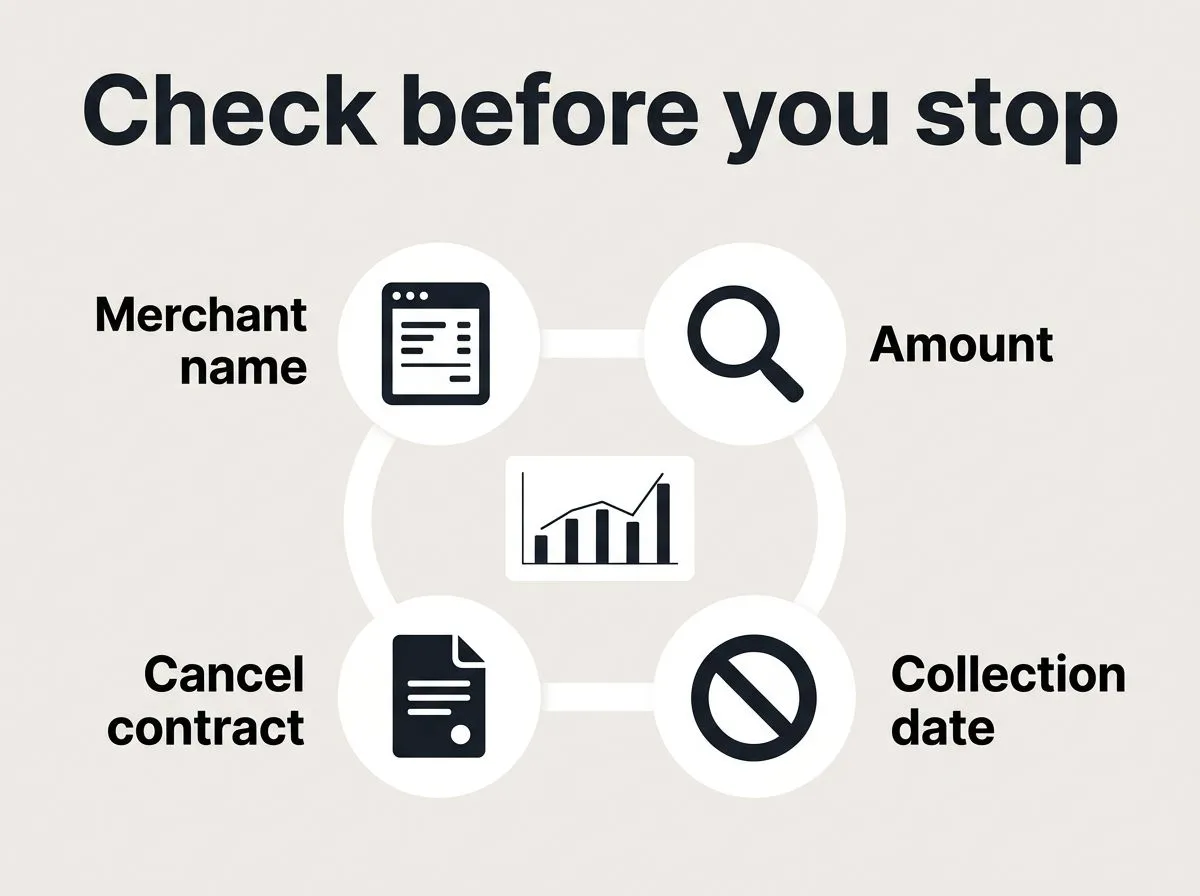
- Check the debit order in your banking app or statement and confirm the merchant name, the amount and the collection date. If those three details do not match your records, you already have enough information to start a dispute.
- If the debit order is unauthorised, wrong or duplicated, contact your bank first and ask which debit order dispute route applies. Banks work under PASA rules, so the route they give you matters more than guessing at the right form.
- Contact the merchant if the amount is wrong, the bill has already been settled, or the mandate needs to be amended or cancelled. Many problems are billing errors rather than fraud, and the merchant is the fastest place to fix those.
- Separate stopping a debit order from ending the contract. Stopping future collections blocks money from leaving your account, but it does not cancel the underlying service or legal obligation unless the merchant agrees or the contract ends.
- If the bank and the merchant do not resolve it, escalate through the relevant complaints or ombudsman route with your proof of authorisation, account history and any letters or emails you sent. Good records matter because they show whether the collection was approved, mistaken or abusive.
The common beginner mistake is to stop the debit order and assume the service has ended. That only solves the banking side. If you still owe the merchant under the contract, the debt can remain even though the collection has been blocked.
The other mistake is to wait until several collections have passed before checking the mandate. A quick review of the first debit order often shows whether the problem is an error, a duplicated collection or a mandate that was never properly set up in the first place.
So, are debit orders still the safest way to pay monthly bills?
Debit orders are still the safer choice for many fixed, recurring bills, but only when the mandate is properly authorised and the customer watches the account. DebiCheck improves safety at the setup stage by forcing bank-side approval, which is a real advantage over older EFT debit order arrangements. The method becomes less attractive when the amount changes often, the mandate is unclear, or you need instant control over every payment.
The practical decision is usually narrower than people think. Choose a debit order if you want reliable automation and the bill is stable. Choose a recurring card payment if you want easier cancellation and the bill is subscription-like. Choose manual EFT if you want full approval before every transfer and can live with the extra admin.
For most South African households, the safest monthly-bill strategy is not one payment method for everything. It’s using DebiCheck for predictable obligations, keeping cards for services you may want to stop quickly, and reserving EFTs for bills that change or need a second check. That mix gives you more control than relying on a single rail for every account.
Frequently asked questions
Can a debit order be collected if I do not have enough money in my account?
Yes, it can still be presented, but payment depends on your available balance, your bank’s rules and the type of debit order. If the money is not there, the collection may fail and you could be charged a fee, so a debit order is only as safe as the cashflow behind it.
What is the difference between a stop payment and cancelling the service contract?
Stopping the debit order only blocks the bank from paying that merchant from your account. It does not end the underlying agreement, so you can still owe the bill unless the merchant cancels the contract or both sides agree to end it.
Is DebiCheck always safer than a legacy EFT debit order?
Generally, yes, because DebiCheck forces bank-side approval at setup, which makes the original mandate harder to fake and easier to prove later. But it is not foolproof, if you confirm the wrong details or stop watching your statements, problems can still slip through.
Can I dispute a debit order after it has already gone through?
Yes, but the route depends on what went wrong and how long ago the collection happened. If it was unauthorised, duplicated or simply incorrect, your bank will tell you whether you need an immediate dispute, a reversal request or a merchant-side correction first.