
Chinese electric cars in South Africa: what buyers should check first
Chinese electric cars can be strong value in South Africa, but the badge and the range figure are only the starting point. Before you buy or import one, make sure it can be legally registered, charged on the networks you’ll actually use, serviced locally, and resold without a headache over parts or paperwork.
Key takeaways
- Confirm import approvals and registration paperwork before shipment, not after the car lands.
- Get a written landed-cost estimate that includes duty, VAT, port charges and admin fees.
- Check Type 2 and CCS2 charging compatibility against the networks you will actually use.
- Read the battery warranty in full and identify the South African party who will honour it.
- Compare service support and resale value before you sign, because badge value alone will not protect you.
Why Chinese EVs need a different buying checklist in South Africa
Chinese EVs need a tighter checklist in South Africa because the purchase price is only one part of the deal. Charging fit, parts support, paperwork, and resale can shift the real cost quickly. This guide is for South African buyers weighing a local purchase or an import, and the working checklist is compliance, landed cost, charging, warranty, service support, and resale.
That matters more with brands such as BYD, GWM Ora, Omoda, and Jaecoo, because model availability, local support, and import status can vary from one car to the next. A glossy spec sheet won’t tell you whether the car can be registered, repaired, or insured with confidence once it lands here.
The common mistake is to treat range and screen size as the whole story. For an EV, the real question is whether the car will work on South African roads, South African plugs, and South African paperwork.
What documents and approvals you need before an EV can be imported and registered
An imported EV needs the right import papers and South African approval before it can become a road car. Start with the bill of lading, commercial invoice, and proof of purchase, then confirm the vehicle’s road-legal status with the relevant South African authorities before shipment.
- Ask the seller or broker for the bill of lading, commercial invoice, and proof of purchase before you pay the balance.
- Check with the National Regulator for Compulsory Specifications (NRCS) and the Department of Transport, South Africa, whether the model needs local approval or homologation evidence before it can be registered.
- Confirm what NaTIS will require for registration, including the identity and import trail for the vehicle, before the car leaves port.
- Get written proof of what will be handed over on delivery, because a vehicle that can arrive in South Africa is not the same thing as one that can be legally registered and driven there.
That last point is where many first-time import buyers slip up. A car can physically enter the country, clear customs, and still fail the practical test if the paperwork trail doesn’t satisfy the registration process.
Which taxes, duties, and landed costs can apply to imported electric cars
The landed price of an imported EV is usually higher than the sticker price once duty, VAT, port costs, and admin charges are added. The exact amount depends on how the vehicle is classified and on the current official schedules from SARS, so buyers should treat any off-the-cuff estimate as provisional.
| Cost item | What it can include | Why it matters |
|---|---|---|
| Customs duty | Import duty on the vehicle category | It can change the landed cost sharply |
| VAT | Value added tax on the taxable import value | It is usually one of the biggest additions |
| Port and clearing charges | Handling, storage, agent and release fees | These are easy to forget and hard to avoid |
| Registration and licensing | NaTIS-related registration and annual licensing | You still need to budget for getting the car onto the road |
| Admin costs | Broker, document, and compliance paperwork | Small charges stack up fast on a high-value import |
A low ex-factory price can turn into an expensive purchase once these layers are added. The sensible move is to ask your clearing agent for a written landed-cost estimate before you commit, then check that estimate against the current SARS rules rather than the seller’s sales pitch.
How to check charging compatibility, battery warranty, and service support
Charging compatibility is the first ownership check, because a car that’s cheap to buy can be awkward to live with if it doesn’t match the plugs and charging speeds you’ll use. Confirm whether the car uses Type 2 for AC and CCS2 for DC fast charging, then compare that with the home charger or public network you expect to rely on.
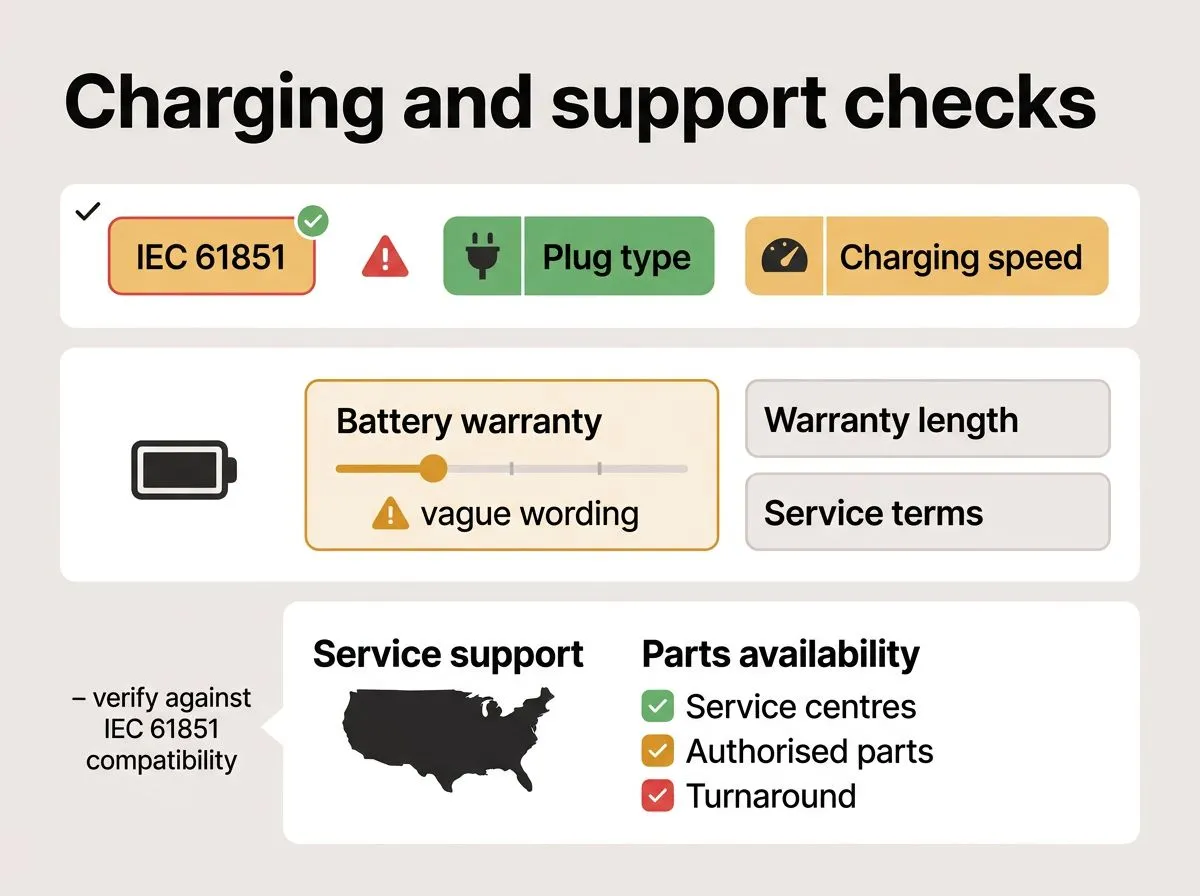
For South African buyers, the question isn’t only which connector is fitted, but whether the car speaks the same charging standard used by the infrastructure. IEC 61851 is the key standard family to know for conductive EV charging, and a mismatch at this level can turn a good deal into a daily nuisance.
Battery warranty and who stands behind it
Battery warranty terms matter because they’re where a cheap import can become a long, costly wait if support is vague. Check the warranty length, mileage limit, exclusions, and, crucially, who in South Africa will honour the claim if the car was imported rather than officially sold here.
Ask for the warranty wording in writing and read the exclusions closely. The usual trap is assuming a broad battery promise automatically covers software faults, charging damage, or every high-voltage component, when the document may only cover specific failures under specific conditions.
Service network and spare parts
Service support only counts when there’s a workshop, diagnostic access, and a clear source of spare parts. If the importer can’t tell you who will carry out high-voltage work, how long common parts take to arrive, and whether software updates are handled locally or remotely, treat that as a warning sign.
The real cost here is downtime, not just repair bills. A small body part or charging component can turn into a long wait if the car has no established South African parts channel, so ask for the dealer or importer’s aftersales contact route before you sign.
How to compare models without getting distracted by badge value
The best way to compare Chinese EVs is to compare ownership facts, not badge prestige. Start with real-world range on the same test basis for each model, then weigh warranty terms, battery coverage, dealer or importer support, insurance ease, repairability, and likely resale strength in the South African market.
That approach stops a spec-sheet winner from becoming a weak long-term buy. A model with a bigger claimed range can still be a poor choice if the support network is thin, the parts path is slow, or insurers are cautious about repairs.
Use total cost to own as the final filter
Total cost to own is the most honest comparison because it includes charging and upkeep, not just the purchase price. Look at what you’ll pay to charge at home, what public charging will cost on your regular routes, and how much routine servicing is likely to add over a year.
This is also where import versus local sale becomes obvious. A locally supported car may cost more upfront, but it can be cheaper to keep on the road if parts, diagnostics, and warranty claims are simpler to process.
Resale, insurance, and the red flags to avoid before signing
Insurance, repair access, and approved parts matter because they shape whether the car stays valuable after you buy it. If an insurer doesn’t know the model well, or the repairer can’t source the correct components, claims can be slower and resale buyers can get nervous.
Resale risk rises when charging fit is awkward, the warranty is short or unclear, the parts supply is thin, or the brand has little recognition in South Africa. Buyers may like the headline price today, but the used-car market remembers practical support long after the showroom discount is forgotten.
The warning signs that should stop the deal
- Unclear homologation or no written guidance on registration.
- Vague warranty wording, especially around the battery and high-voltage systems.
- No South African service plan or no named workshop network.
- No clear aftersales contact for software updates, diagnostics, or parts.
- A seller who can quote the price but cannot explain the charging standard or support path.
If you spot more than one of those signs, walk away or renegotiate until the paperwork and support are clear. The safest buyer-first move is straightforward: check the documents, check the charging, check the support, then decide whether the badge still represents value.
Your final decisions come down to three things. First, decide whether you need a car with local support or whether you can live with import risk, depending on how often you’ll lean on warranty and servicing. Second, check whether the charging standard fits your daily routes and home setup. Third, decide whether resale and insurance are strong enough to justify the purchase price, because that’s where a cheap EV can turn costly later.
Frequently asked questions
Can I register an imported Chinese EV in South Africa if it was not sold locally?
Only if it has the right import papers and passes South African approval checks before it is shipped or landed. In practice, that means confirming the model’s road-legal status with the NRCS and the Department of Transport, and checking what NaTIS will need for the registration trail. A car can arrive in South Africa and still be impossible to register if the paperwork does not line up.
Do imported electric cars pay the same taxes as petrol cars?
Not necessarily. Imported EVs can pick up customs duty, VAT, port and clearing charges, registration costs and admin fees, so the landed price is often much higher than the sticker price. The exact amount depends on how the vehicle is classified and the current SARS rules, so the written landed-cost estimate matters more than the sales pitch.
What should I check in the battery warranty first?
Start with the warranty length, mileage limit and the fine print on what counts as battery degradation or failure. Then check who in South Africa will actually honour the claim, because an imported car may have wording that looks broad but is backed by no local support. Also confirm whether the cover extends beyond the battery to high-voltage components and software-related faults.
Why does charging compatibility matter so much for Chinese EVs?
Because the car has to work with the plugs and charging speeds you will actually use in South Africa. The article says to confirm Type 2 for AC charging and CCS2 for DC fast charging, otherwise a bargain on paper can become inconvenient every day. A mismatch can also make public charging and home charging far less practical than the range figure suggests.