
El Niño in South Africa 2026: what households should prepare for
El Niño is the warm phase of the El Niño Southern Oscillation, or ENSO, and in South Africa it often nudges the season towards hotter, drier conditions in many areas. For households, that means preparing for heat, water stress and garden loss, while keeping in mind that one storm or cool week does not wipe out the wider seasonal signal.
Key takeaways
- Check the latest ENSO bulletin date before you act, because the outlook can change between updates.
- Prepare for hotter, drier conditions by reducing household water use now, not after restrictions start.
- Focus most closely on interior summer rainfall areas, where the seasonal signal can bite harder.
- Use official SAWS and NOAA updates, not reposted graphics, when deciding whether the pattern is strengthening or fading.
What El Niño means and how forecasters identify it
El Niño is the warm phase of ENSO, a Pacific Ocean pattern that shifts sea temperatures and, in turn, influences rainfall and temperature patterns far beyond the ocean itself. Neutral conditions sit in the middle, while La Niña is the cooler phase. For households, the practical difference is simple, each phase pushes the odds of seasonal weather in a different direction.
Forecasters do not work from one hot week and a hunch. They look at sea surface temperature anomalies in the central and eastern tropical Pacific, whether the atmosphere is coupling to those ocean changes, and the probability that the pattern will persist into the coming season. That is why a bulletin that says “50% chance” or “likely neutral” matters more than a single headline, because it tells you how confident the outlook is and over what lead time.
For South Africans, the official places to watch are the South African Weather Service (SAWS), the NOAA Climate Prediction Center, and the International Research Institute for Climate and Society, with the World Meteorological Organization helping to frame the global picture. Use those sources for the latest published outlooks, not reposted graphics or old seasonal headlines.
What the 2026 forecasts currently say, and how to verify the official update
The safest reading of 2026 is the latest published outlook from SAWS, NOAA CPC and IRI, because ENSO status can shift between bulletins. SAWS is the most useful source for South African context, NOAA CPC for ENSO status and global monitoring, and IRI for probability updates that show whether the system is leaning towards El Niño, La Niña or neutral conditions.
When you open a bulletin, look first for the ENSO phase, then the forecast horizon, then whether the signal is strengthening, weakening or staying near neutral. That order matters, because a short-range note can sound dramatic even when the seasonal probability has barely moved, and a weakening signal may matter less for household planning than one that keeps holding.
The practical check is straightforward: treat the latest published outlook as current, and ignore a single social post or old screenshot if it clashes with the official update. If you only have time to check one thing, check the date on the bulletin before you read the wording.
Likely seasonal effects in South Africa: heat, rainfall and water stress
In South Africa, El Niño often means a higher chance of hotter and drier seasonal conditions in many places, especially when the signal is strong enough to influence the summer rain pattern. That does not mean every town turns dry, but it does push the odds towards more evaporation, weaker soil moisture and greater pressure on household water use.
The key distinction is between seasonal tendency and daily weather. A single thunderstorm can still break a hot spell, and a cold front can still bring a brief cool-down, but those events do not erase the broader seasonal trend that forecasters are tracking across months rather than days.
For households, the practical effects are familiar and costly. Gardens dry out faster, tanks and municipal supplies are stretched harder, and in some places the fire risk rises because grass and brush cure more quickly. If your household already runs on a tight water budget, El Niño makes slack disappear fast.
Which provinces and household risks deserve the closest attention
The provinces and regions most often watched closely are the interior summer rainfall areas, especially parts of the Free State, North West, Gauteng, Mpumalanga, Limpopo and the eastern interior of the Northern Cape, because those areas can feel hotter, drier seasonal pressure more quickly. Coastal and southern areas still need attention, but the household impacts there are often shaped more by local rainfall swings and municipal water systems than by a simple one-size-fits-all El Niño rule.
What matters at home depends on what you live on. A city flat may need to focus on water outages, kitchen storage and backup cooling, while a smallholding or rural household will also care about grazing, fodder, tank levels and fire breaks. That is why the same seasonal outlook can mean very different actions in Johannesburg, Polokwane, Kimberley or a farming district.
Watch local notices as closely as the national outlook. Municipal water restriction alerts, district rainfall outlooks, and seasonal updates from the Department of Water and Sanitation, the Agricultural Research Council and the National Disaster Management Centre are the signals that turn a broad climate pattern into a concrete household decision.
How households should prepare gardens, food storage and water use
Households should start with water-saving in the garden, because that is often the quickest place to lose litres without noticing. Mulch beds, water early in the morning, and favour plants that tolerate dry spells rather than high-demand bedding plants that collapse after a short heat run.
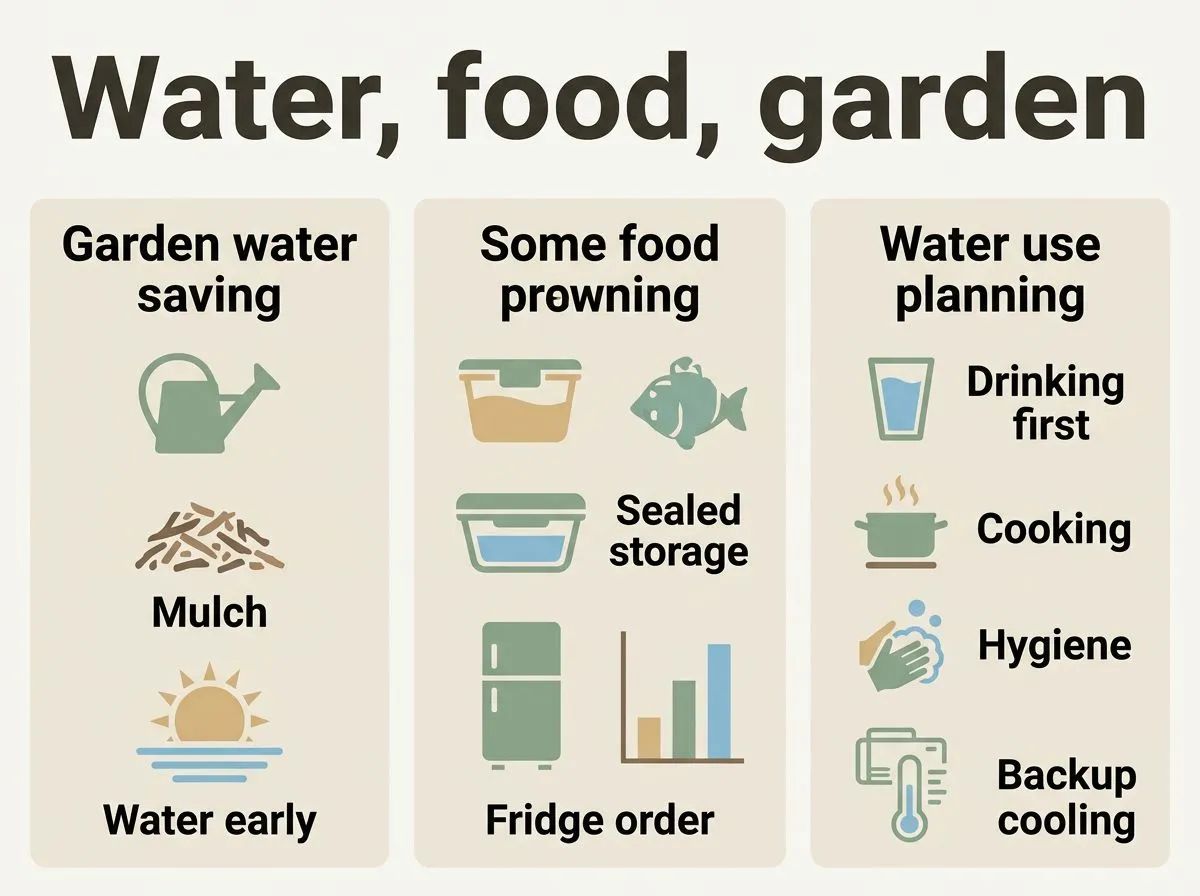
Food storage needs a simple check, especially if you live where outages or supply interruptions are more likely during heat and high demand. Keep the fridge and freezer organised so you know what must be used first, store drinking water in clean covered containers, and make sure the household can keep essentials cool for at least a short disruption without panic buying.
Water planning should be specific, not vague. Decide what the stored water is for, drinking first, then cooking, then hygiene, and only then cleaning and gardening, because a tank emptied on the lawn is no help if the taps run dry. If you have a tank, fill it before restrictions bite, not after the first low-pressure warning.
The best prep is the kind you do in the next few weeks. Cut back wasteful outdoor watering, check hoses and storage containers for leaks, and make sure everyone in the house knows where the backup water, torches and any battery packs are kept. If you wait for the first severe heat warning, you usually pay the highest price for the least time to get ready.
How to follow official weather updates and act on warnings
- Check South African Weather Service seasonal outlooks and severe weather warnings regularly.
- Use the National Disaster Management Centre and local municipal channels for disaster or water restriction notices.
- Match the warning level to the action: monitor, prepare, or move to immediate protective steps.
The first action level is monitor, which means the seasonal signal is worth keeping an eye on, but not yet worth major spending. The second is prepare, so top up water storage, tighten up garden use and check supplies before demand starts climbing. The third is immediate protective action, which comes after a severe weather or restriction notice and should set off the steps you already planned, not a fresh scramble to improvise.
The bottom line for households in 2026
The three decisions still to make are straightforward: whether your household needs water storage now, which outdoor areas can be cut back before heat arrives, and which official source you’ll check first each week. If you live in a drier inland area, water security is the main test; if you live near a municipal supply that already runs tight, resilience to interruptions matters most.
For South African households, the sensible response to El Niño is timing, not alarm. Use the latest SAWS, NOAA CPC and IRI updates, keep an eye on how your own province is trending, and act early on the items that get expensive or awkward once the weather turns hot and dry.
Frequently asked questions
How far ahead can El Niño forecasts be trusted?
The seasonal signal is useful months ahead, but it should not be treated like a day-by-day weather forecast. Forecast confidence is best read from the bulletin date, the stated lead time and whether the outlook says the signal is strengthening, weakening or holding near neutral. Use seasonal outlooks for planning, then rely on South African Weather Service warnings for the immediate risk.
Does an El Niño forecast mean drought in every part of South Africa?
No. El Niño raises the odds of hotter, drier conditions in many inland areas, but it does not switch the whole country into drought at once. Local rainfall, municipal supply and short-lived storms can still break the pattern, so provincial and municipal updates matter more than the headline label alone.
What should households prioritise if water restrictions begin?
Protect drinking water first, then cooking and hygiene. If you have storage, fill it before restrictions bite, not after the first low-pressure warning, and cut non-essential outdoor use early. The mistake to avoid is spending stored water on the garden while the household is still short indoors.
Where should readers check if the forecast has changed since publication?
Check the latest South African Weather Service seasonal outlook and severe weather warnings first, because they give the most relevant local context. If you want the wider ENSO picture, cross-check with NOAA CPC and the IRI bulletin, but always use the most recently published update rather than an old screenshot or repost.