Eskom tariff increase 2026: what it means for home budgets
If your household electricity bill is climbing in 2026, check the official tariff notice first, not reposted screenshots. For Eskom direct customers, Nersa approved an average 12.74% electricity tariff increase for 2026, effective from 1 April 2026, with changes affecting energy charges and, where applicable, fixed charges. The practical impact depends on whether you are billed directly, buy prepaid tokens, or pay through a municipality.
Key takeaways
- Check the official tariff notice before you budget, because the effective date can land on different billing cycles in 2026.
- Your bill may rise in both the unit rate and fixed charges, so a 10% tariff change does not always mean a 10% higher total.
- Prepaid, direct Eskom and municipal customers can see different rand increases, even under the same approved tariff.
- Winter usage matters: the more units you consume at peak times, the faster the increase shows up on the bill.
This guide is for South African electricity tariffs, not UK utility pricing. For the current figure, rely on Eskom’s published tariff schedule PDF, Nersa’s approval notice, or your municipality’s tariff book, depending on how your account is billed.
What the 2026 Eskom tariff increase is, and when it takes effect
The 2026 Eskom tariff increase is the approved change to electricity charges for the 2026 tariff year, and the number you should use is the one published by Nersa or Eskom in the official notice. Nersa’s 2026 approval, effective from 1 April 2026, is the reference point, and the new rate can show up on different billing cycles, so one household may see it on an early invoice while another only notices it on the next token purchase or municipal statement.
That’s why the paper trail matters more than the headline. Use the official tariff PDF or approval notice as the source of truth, because social media summaries and forwarded screenshots often leave out the customer class, the date, or the tariff band that actually decides what you pay.
How the increase is structured across charges, bands and VAT
| Charge item | Who it affects | How it usually changes | Where to check the exact 2026 figure | VAT treatment | Notes on fixed versus usage-based charges |
|---|---|---|---|---|---|
| Energy charge | All households that buy electricity units | The rand per kWh changes with the approved tariff | Eskom tariff schedule PDF or municipal tariff book | Usually VATable where billed | Usage-based, so heavier use pushes the bill up fastest |
| Fixed service or network charge | Some direct and municipal customers | May stay the same or rise separately from the unit rate | Approval notice and account breakdown | Usually VATable where billed | Fixed, so it bites harder on low-usage homes |
| Inclining or block tariff band | Customers on stepped tariffs | Each band can move differently, so the first units may not cost the same as later units | Tariff schedule for your customer class | Usually VATable where billed | Usage-based, but the rate depends on how much you consume |
| Prepaid token price | Prepaid customers | The token value reflects the approved tariff and any municipal add-ons | Vendor receipt and tariff schedule | Included in the final token price | Mostly usage-based, though the price can include other approved charges |
| Municipal add-ons and levies | Customers billed by a municipality | May change alongside or separately from Eskom’s direct tariff | Municipal tariff book | Set by the municipality and usually VATable where applicable | Can make the final bill differ from Eskom’s headline increase |
Which customer classes are affected, and how prepaid, direct and municipal customers differ
- Direct Eskom residential customers usually see the approved change on a billed account, where the unit price and any fixed charge update on the billing cycle that follows the effective date.
- Prepaid customers buying through Eskom or through a municipality may see the change in token prices, and the token amount can move differently depending on the tariff band and local add-ons.
- Households billed by a municipality pay the tariff in the municipal tariff book, so the final bill can include municipal network costs, service charges or local adjustments on top of the Eskom supply component.
- Time-of-use or block tariff users can feel the change unevenly because the unit price in one band can move more than another, which matters most if you use electricity in the highest-cost hours or in the upper consumption bands.
- The same percentage increase can produce different rand increases because a home that uses more units, or pays more fixed charges, starts from a larger base than a low-usage household.
How to find the latest published tariff document on official pages
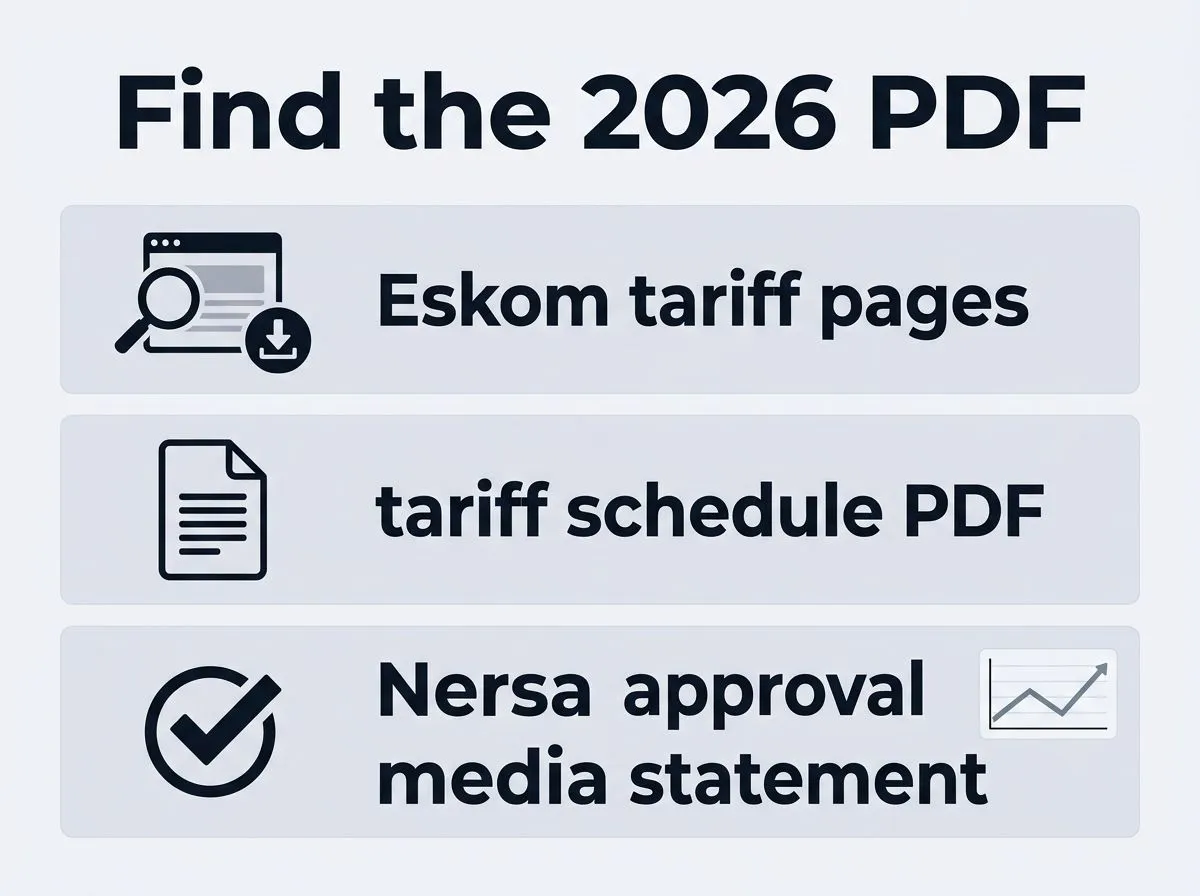
- Open Eskom’s official tariff pages and downloads section, then look for the current tariff schedule PDF for the 2026 tariff year.
- Check Nersa’s approved tariff decision or media statement, and match the approval date with the effective date shown in the document.
- Confirm the PDF title, version date and customer class, because a residential schedule is not the same as a business or municipal schedule.
- Match the tariff book to the correct supply type, direct Eskom supply or municipal billing, before you use the figures in a budget.
- If your account comes from a municipality, check the municipal tariff book as well, because the final amount may be set there rather than in Eskom’s own schedule.
What the increase means for winter bills and peak household use
The increase applies to the energy charge first, and in some tariff classes it also affects fixed charges such as service or network components. That’s why winter bills often feel sharper than the headline number suggests: you use more power for heating, cooking and lighting, and the higher volume pushes the tariff rise up in rand terms.
For budgeting, the most useful check is last winter’s bill. Take your highest realistic monthly total, recalculate it using the approved new unit rate, then leave room for a small buffer for colder weeks or extra evening use. If you are on time-of-use pricing, shift flexible tasks such as laundry or water heating away from peak periods where possible, because the tariff structure punishes expensive timing as well as high consumption.
The households that feel the least strain are usually the ones that know their own load pattern and act before the new charges land. The common mistake is budgeting from an average summer bill, which underestimates both consumption and the effect of the tariff rise.
What you should do next with your household budget
Use the official 2026 tariff document first, then compare it with your own bill type, because the right answer depends on whether you are direct Eskom, prepaid, or municipal. If your numbers come from a municipal tariff book, that book, not a reposted Eskom summary, is the figure that shapes your household total.
Frequently asked questions
When does the 2026 Eskom increase show up on a household bill?
It starts from the tariff’s effective date, but the first bill affected depends on your billing cycle and whether you are billed by Eskom or by a municipality. In practice, one household may see the higher charge on an early invoice, while another only feels it on the next token purchase or statement.
Where can I download the current tariff PDF?
Use Eskom’s official tariff pages and downloads section first, then confirm the approved notice from Nersa. Match the PDF to your customer class, supply type and effective date, because the residential schedule is not the same as a business or municipal one.
Do prepaid customers pay the same increase as direct-billed customers?
Not always in the same way. The approved increase may be the same headline figure, but prepaid pricing and direct bills can differ because of tariff structure, fixed charges and municipal add-ons.
Why does my bill go up by more than the headline percentage?
Because your total bill is not just the unit price. Usage, fixed service charges, municipal fees and VAT can all sit on top of the tariff increase, so a household that uses more electricity, or pays higher fixed charges, can see a larger rand jump than the headline percentage implies.