
How South African freelancers can price work in rand
South African freelancers can price work in rand by starting with a realistic monthly income target, adding business costs and unpaid time, then dividing that total by billable hours. That gives you a floor, not a guess. From there, pick the pricing model that fits the job, then adjust for tax, VAT and scope so the quote stands up.
Key takeaways
- Use a monthly income target plus business costs, then divide by billable hours to get your floor rate.
- Do not price as if all 160 hours in a month are sellable, because admin and sales time cut billable time.
- Freelance rates in South Africa can sit as low as R20 per hour or above R400 per hour, depending on the work.
- If you register for VAT, the threshold to watch is R1 million in taxable supplies in any 12-month period.
- For project quotes, build in at least one revision buffer so scope creep does not wipe out your margin.
What freelance rates look like in South Africa right now
The clearest benchmark is that rates in South Africa vary sharply by profession, experience and type of client, with a 2019 to 2020 media sector report showing many freelancers still clustered at the lower end of the market and 33% earning less than R10,000 a month ResearchGate. That matters because the figure shows a wide, uneven market that is still underpriced in places, so a single “average” is a weak base for your own rate.
| Profession or service | Experience level | Typical rate range in rand | What drives the rate up or down |
|---|---|---|---|
| Magazine writing | General freelance media market | R3 to R4 per word or R400 to R500 per hour | Depth of research, publication budget, turnaround time |
| Newspaper writing | General freelance media market | R3+ per word or R400 to R500 per hour | Speed, news value, editorial standards |
| Corporate content | General freelance media market | R500 per hour, R5,000 half day, R5,000 to R8,000 full day | Client usage rights, strategy input, revision load |
| Events photography | General freelance media market | R100 to R200 per image, R850 to R1,500 per hour, R3,000 to R5,000 half day, R4,500 to R7,500 full day | Shoot length, editing, travel, usage |
| Editorial or advertorial photography | General freelance media market | R800 per image, R800 to R1,500 per hour, R3,000 to R5,000 half day, R5,000 to R8,000 full day | Creative direction, licensing, production complexity |
| Wedding photography | General freelance media market | R50 to R100 per image, R600 to R1,200 per hour, R4,000 to R7,000 half day, R7,000 to R12,000 full day | Coverage hours, deliverables, post-production |
| Freelance graphic designer | Average South African benchmark | Around R243.03 per hour in 2026 | Software, specialism, speed and portfolio strength |
| Freelance writer | South African pay range | R20 to R405 per hour | Client type, niche, seniority and whether the job is commodity work or specialist work |
| Copywriting skill | South African market range | R150 to R450 per hour, average R250 | Strategy involvement, brand risk, conversion focus |
These figures are useful as anchors, not as targets to copy blindly. A specialist who knows legal, technical or branded work can move above the lower end quickly, while a beginner who is still building speed may need to stay within the market range until output improves.
Platform listings can help you see how global marketplaces describe South African pricing, but they are not the same as a local rate card. Upwork notes that freelancer rates in South Africa typically range from $5 to $45 per hour and rise with skill, experience, project complexity and specialisation Upwork, which is a useful reminder that the job, not only the country, sets the ceiling.
How to calculate your own rate from income goals, costs and billable time
Your own rate should come from a monthly number you actually need to earn, not from what other people are quoting. Conta’s freelance rate calculator for South Africa is built around that logic, and it is the right starting point because it forces you to account for the whole working month instead of only the hours you can sell Conta.
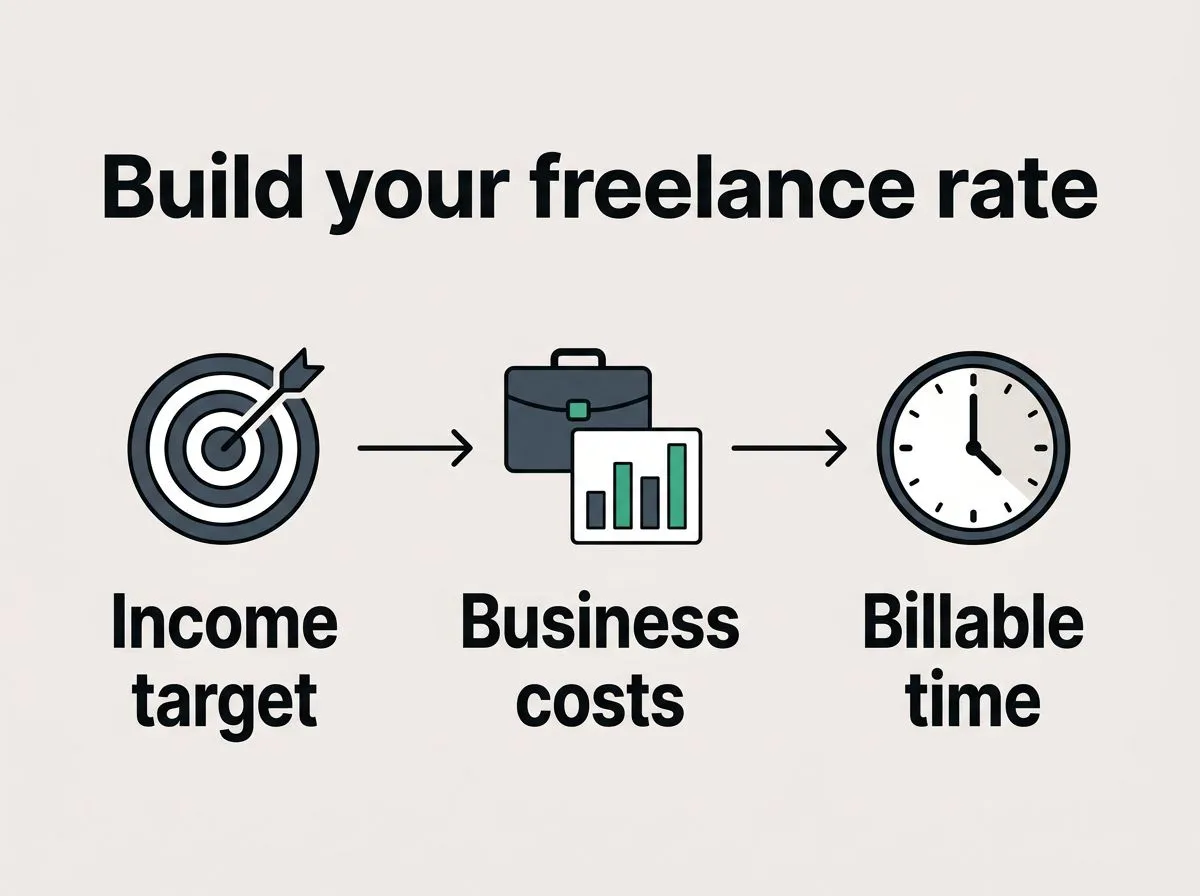
- Set a monthly income target. Start with the amount you need to take home for personal living costs, then add the business money you must earn on top, such as software, data, insurance, rent, equipment replacement and any subcontractor help. If you skip those costs, your rate will look fine on paper and fail in cash flow.
- Add business costs and allow for downtime. Freelancers do not invoice every working hour, so build in time for pitching, admin, late payment chasing, revisions and quiet weeks. The practical mistake is pricing as though all working days are billable, because that makes the rate too low from the first quote.
- Estimate billable hours realistically. Look at a normal month and count only the hours you can actually invoice, not the hours you are at your desk. If you work 160 hours a month, your billable hours may be far fewer once meetings, sales and admin are removed, and that difference is what protects your margin.
- Convert the total into hourly, day and project rates. Divide the monthly total by billable hours for an hourly rate, then multiply by the hours in a day for a day rate. For project work, estimate the number of hours honestly and add a buffer for revisions, because project pricing without a margin for changes is just a delayed hourly quote.
The main risk here is underestimating non-billable time. South African freelancers who price only on task time often end up subsidising client communication, scope creep and unpaid admin. A better rate is one that survives a slow month, because a fast month will hide weak maths.
How to quote, revise and price for tax in South Africa
Charge per hour when the scope is uncertain, per project when the deliverable is clear, and per day when the client needs your time rather than a fixed output. That is the cleanest way to match the pricing model to the risk in the job, and it stops small vague assignments from turning into open-ended work.
When hourly, project and day rates each make sense
Hourly pricing works best for consultancy, troubleshooting and work where the client keeps changing direction. Project pricing is better for defined outputs such as a website page set, an article package or a campaign asset list, because the client is buying an outcome rather than your clock. Day rates are useful on-site, for workshops or for jobs where the client wants concentrated availability.
The practical trade-off is straightforward. Hourly protects you when a client drags the brief sideways, but it can penalise efficiency, while project pricing rewards speed but punishes poor scoping. If you are faster than average, project pricing often earns more, provided the brief is tight enough to hold still.
How to define scope, revision limits and change requests
A quote should name the deliverable, the deadline, the number of revision rounds and what counts as extra work. The strongest habit is to spell out what is included, then give a separate line for anything outside it, such as fresh concepts, extra pages, additional formats or urgent turnaround. That is how you stop a small change request from becoming a free redraw.
Revision limits matter because clients often assume “small tweaks” are free forever. Put the limit in writing, then state that changes to the brief, new source material or extra approvals are billed separately. A beginner’s mistake is soft wording, because vague language invites exactly the kind of drift that eats profit.
How income tax and provisional tax affect what you keep
Your quote has to leave room for income tax and, if relevant, provisional tax, because gross turnover is not take-home pay. South African Revenue Service rules decide what you owe and when you owe it, so the safest habit is to treat tax as money held back rather than money left over.
That changes pricing behaviour in a very practical way. If you quote too close to your personal spending needs, the tax bill arrives later and exposes the gap. Freelancers who price properly usually build tax into their monthly target before they divide by billable hours, which keeps the final rate honest.
When VAT registration changes the quote
VAT registration matters once you are in the VAT system, because you then need to quote with VAT in mind under the VAT Act in South Africa. The key consequence is that your client may see a higher invoice total even if your pre-tax fee stays the same, so the number you say out loud and the number on the invoice are not always identical.
The practical mistake is quoting as though VAT does not exist and then trying to absorb it later. If your business is registered, make the quote clear enough that the client understands whether the figure is VAT-inclusive or VAT-exclusive. That avoids awkward renegotiation after approval and keeps your pricing credible.
Local rate evidence from SAFREA, MediaUpdate and PayScale is useful here because it shows the market is already split by service type and seniority, not by one universal freelancer price MediaUpdate, PayScale. Research on freelance markets also shows that income can be uneven and patchy, so pricing with tax and scope in mind is not cautious, it is basic survival.
The best rand rate is the one that covers your real monthly costs, gets you through quieter months, and still leaves room for tax without pushing you into a renegotiation later on. Use market data as a boundary, your billable hours as the maths, and then pick the pricing model that fits the risk in the brief. If a client can’t work with that structure, the problem is often the scope, not the rate.
Frequently asked questions
Should I show my rate as hourly, daily or per project?
Use the format that matches how the client is buying the work. Hourly suits open-ended support, daily rates suit on-site work, workshops or sprint-style days, and project fees suit jobs with a clear brief and fixed deliverables. If the scope is still moving, hourly is usually the safer choice because it leaves less room for unpaid extras.
How do I stop clients from asking for endless revisions?
Set the number of revision rounds in writing, define what counts as a revision versus a change in scope, and charge extra once the agreed limit is reached. A quote should also spell out the deliverable and the deadline, so a “small tweak” cannot quietly turn into new work. The more specific the brief, the easier it is to defend the limit.
What if my rate is higher than the market average?
Keep the quote tied to scope, speed, specialist skill and outcome. A higher rate is easier to defend when the brief is specific and your deliverables are measurable, because the client can see exactly what they are paying for. In a market as uneven as South Africa’s, a single “average” is a weak benchmark anyway.
Do I need to charge VAT on freelance work?
Only if you are VAT-registered, which depends on your taxable turnover and your registration status with SARS. If you are registered, your quote needs to be clear about whether the figure is VAT-inclusive or VAT-exclusive, so the client does not get an unexpected total later. Check the latest SARS rules before you invoice.
How often should I review my rates?
Review them whenever your costs, income targets or demand change materially, and at least once a year so your pricing does not lag behind inflation and your own experience. It is worth checking again after a period of strong demand or a big rise in business costs, because both can shift your floor rate quickly.