How South African households can cut electricity use at night
How South African households can cut electricity use at night starts with one simple move: stop the biggest loads running when they’re least useful, then check whether your tariff actually makes that cheaper. In most homes, the savings come from the geyser, heating, cooling and standby devices, but the maths changes if you’re on a time-of-use tariff or prepaid setup.
Key takeaways
- Focus on the biggest overnight loads first, especially the geyser, heaters and air-conditioning, before chasing small standby savings.
- Night use is not automatically cheaper: on a flat tariff, midnight costs the same as 6 pm, while time-of-use plans depend on the rate band.
- A geyser timer should give enough recovery time before morning, but it should not keep the tank hot all night if nobody needs the water.
- Switch off TVs, decoders, printers and chargers at the wall when they are not needed, because standby draw adds up overnight.
- Measure the result on your next bill or prepaid history, then keep the change that cuts consumption without disrupting mornings.
What actually uses electricity after dark
- The biggest overnight loads are usually the geyser, air-conditioners, dishwashers, fridges and freezers, because each one can draw far more power than a light or a charger. Eskom’s “Use electricity smartly” campaign specifically calls out geysers, pool pumps and air-conditioners as the first places to look, which is a good clue about where the real money goes.
- Standby power also adds up overnight. A router and modem, TVs, decoders, printers and chargers may look switched off, but many still draw electricity while idle or plugged in, so the problem is often what stays connected rather than what is visibly running.
- Evening routines push use up. Cooking supper, bathing children, switching on heaters, TVs and lights, and using hot water after dark all raise consumption at the same time, which is why the evening peak is so hard to ignore.
- The easiest savings usually come from the heaviest appliances, not from chasing every tiny load. A fridge or freezer runs continuously for food safety, so it is not the first thing to switch off, while a geyser or heater often offers far more room to cut waste without changing the household’s whole day.
How South African tariff structures change the cost of night electricity use
| Pricing context | Typical night window | What is usually cheaper at night | What is not automatically cheaper | What to check | Who it applies to |
|---|---|---|---|---|---|
| Flat tariff | No special off-peak window | Nothing changes just because it is night | Any appliance used after dark still costs the same per unit | Your bill or tariff sheet for the single unit rate | Households on a standard fixed-rate electricity plan |
| Time-of-use tariff | Often an off-peak period overnight, but the exact hours depend on the supplier or tariff sheet | Some heavy loads can be cheaper when they run in off-peak hours | Midnight is not automatically cheaper if your tariff marks that time as standard or peak | The tariff page, your municipal schedule, or your Eskom schedule for the exact time bands | Households on a TOU tariff, such as Homeflex or a municipal time-of-use option |
| Prepaid electricity setup | No universal night discount unless the tariff attached to the meter has one | You may save only if your tariff gives cheaper off-peak units | Simply buying prepaid does not make night use cheaper by itself | The prepaid meter tariff name, current price list and any time-band rules on your provider’s notice | Households using prepaid electricity meters |
| Municipal or utility-specific time-of-use plan | Defined by the local supplier, not by the clock alone | Night use can be cheaper where off-peak rates are lower | A device running at night can still be expensive if it falls inside peak or standard time | The local tariff document, including the supplier’s off-peak hours and seasonal rules | Customers covered by a municipality or utility TOU tariff such as the City of Cape Town option |
Practical ways to cut overnight consumption without changing your whole routine
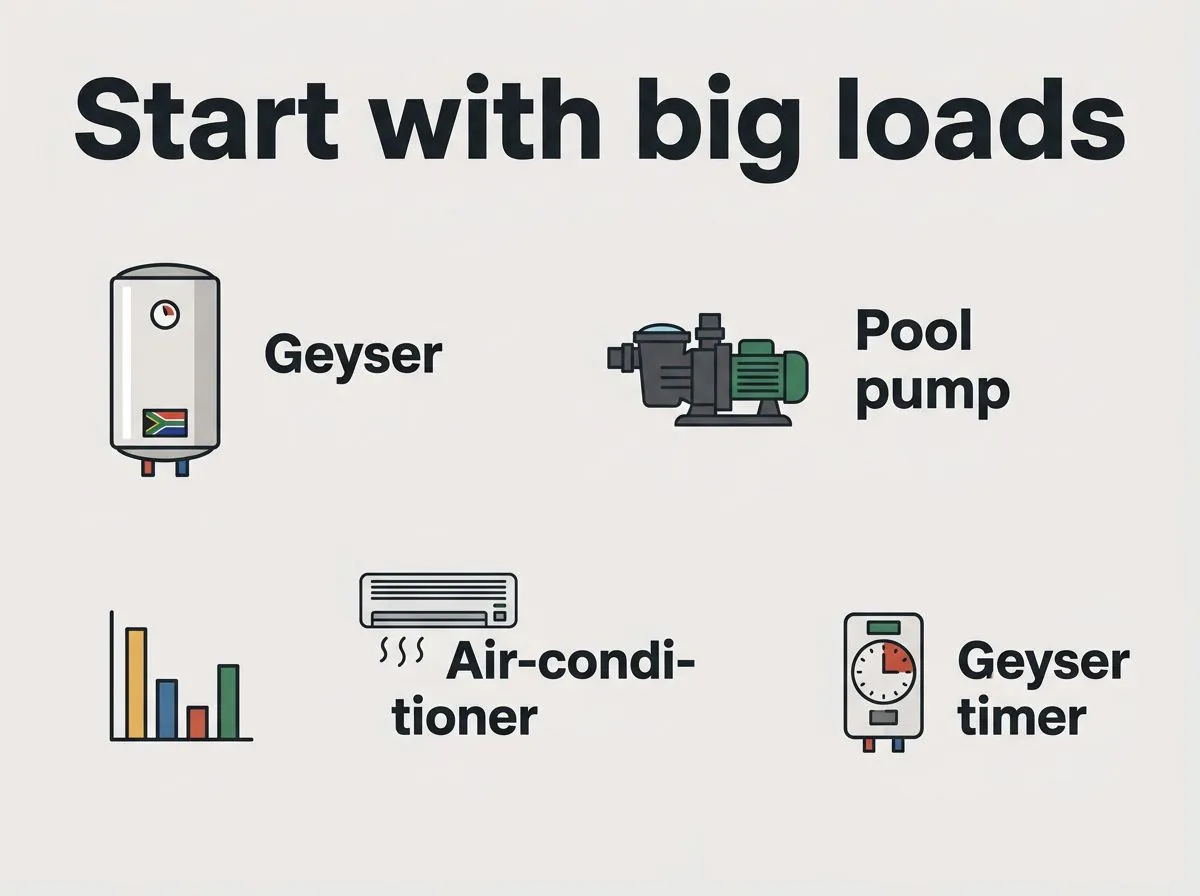
- Start with the geyser, pool pump and air-conditioner, because these are the loads Eskom highlights first and they usually offer the fastest savings. If you have a geyser timer, set it so the tank heats only when hot water is needed, not all night, and make sure the switch still leaves enough recovery time before morning use. The common mistake is setting the timer too broadly, which keeps the tank hot for hours that no one uses it.
- Use smart controls where they fit, but only on appliances that benefit from scheduling. A geyser timer is useful because hot water can be stored, while a fridge, freezer or modem should not be put on a timer in a way that interrupts essential operation. If you are not sure the wiring or control method is safe, get a qualified electrician rather than opening the unit yourself.
- Cut standby waste at the wall socket. Switch off TVs, decoders, printers and chargers when they are not needed, and unplug the small items that keep sipping power after everyone has gone to bed. This is safe to do yourself as long as you are using the plug, not tampering with fixed wiring or a damaged socket.
- Move laundry, dishwashing or other flexible tasks only when your tariff rewards the move. On a flat tariff, shifting a load to midnight changes convenience more than cost, but on a time-of-use plan the same job may be cheaper in off-peak hours. The wrong habit is assuming late-night use always saves money without checking the rate band first.
- Treat small savings as support, not the main event. The easiest gains usually come from one or two heavy loads that run too long, not from obsessing over every phone charger in the house. If the bill barely changes after you trim the obvious loads, the next step is to check whether a heater, geyser setting or timed appliance is still running longer than you think.
How to measure whether your changes are working
Record a baseline before you change anything, then compare the same time of day after a few nights or after one full billing cycle. Take the meter reading or prepaid keypad reading at the same hour each day, because a random check on one night tells you very little about a pattern. On the bill, look at units used, not just the amount owed, and if your tariff shows separate time-of-use categories, compare the night band rather than the total alone.
Weather, guests and a different bedtime routine can distort a single night’s result, so the useful test is repeated readings over several days.
If you’re on a prepaid system, that steady comparison is often easier because the balance drops visibly as units are used, while a postpaid bill may only show the effect clearly at the end of the cycle.
If the numbers do not move after the change, the biggest overnight load is probably still on, or the tariff you’re on does not reward the change you made.
For households wanting a rough sense of whether they’re in the right territory, the research from J-PAL on Cape Town prepaid meters found average use fell by 1.9 kWh per day after households switched to prepaid, from about 16.21 kWh before the intervention, and the effect lasted at least 12 months.
That does not mean every home will see the same drop, but it does show why measurement matters: a real saving shows up in the units, not just in the feeling that you used less.
How to decide what to change first in your own home
Choose the biggest overnight load first if your goal is faster savings, the easiest timed appliance if your household needs comfort, and the tariff band if you’re trying to move use to a cheaper period. Homeflex-style and municipal time-of-use plans can make night use cheaper, but only when the hours on your own tariff sheet say so, and Eskom’s evening-peak advice still matters because many homes use the most electricity between 5 pm and 9 pm.
The practical rule is straightforward: cut waste where the power draw is highest, schedule only what can safely be scheduled, and confirm the result with your meter or bill. That’s the difference between a bill that actually falls and one that only feels better because the kettle ran later.
Frequently asked questions
Does switching appliances off at the wall really save electricity overnight?
Yes, especially for devices that still draw standby power, such as routers, modems, TVs, decoders and chargers. The saving is small on one item, but it becomes more noticeable across a whole house, particularly when several devices stay plugged in all night.
Is it cheaper to run a washing machine at midnight in South Africa?
Only if your tariff makes midnight an off-peak period. On some time-of-use plans it can be cheaper, but on others the night window may not differ much from the rest of the day.
How do I know if my geyser is the main reason my overnight bill is high?
Check which appliance is drawing the highest load for the longest time, then compare your meter or prepaid reading before and after you reduce its runtime or fit a timer. In most homes, the geyser is one of the first places to look because it can use far more power than small standby devices.
Will prepaid meters automatically reduce night electricity use?
No, not automatically. They do make consumption more visible, which often helps households spot waste faster and change habits sooner, but the meter only helps if you act on what you see and trim the biggest overnight loads.