
How to choose a South African bank account for travel spending
A good travel bank account for South Africans lets you pay abroad, withdraw cash when you need to, and see the real cost before you tap or take money out.
In practice, the best choice is usually the one with the clearest total cost, the strongest controls, and the fewest surprise charges, such as foreign card payment fees, cash withdrawal fees, and a poor exchange rate.
This guide is for everyday travel spending, if you mainly need business travel facilities or a dedicated corporate travel card, that’s a different decision.
Key takeaways
- Check whether the account lets you freeze and unfreeze your card instantly before you travel.
- Compare the full card cost, not just the monthly fee, because foreign transaction charges can add up on every purchase.
- Plan cash withdrawals around bank and ATM limits, since one large trip to the cash machine is often cheaper than several small ones.
- Confirm your app, alerts and support access still work abroad, so you can fix a blocked card or payment fast.
What a good travel bank account needs to do
A good travel bank account needs to let you spend overseas without card friction, keep the app usable while you’re away, and give you enough control to move quickly if something goes wrong. For most travellers, that means being able to switch card controls on and off in the app, turn on purchase and cash withdrawal alerts, freeze and unfreeze the card, and reach support from abroad.
The real question is how often you travel and how much cash you still expect to need. A standard current account can work perfectly well for a short trip with mostly card payments, because the main job is simply to authorise foreign card spending. A dedicated travel card or multi-currency setup makes more sense when you travel often, want a backup payment method, or need to keep travel spending separate from day-to-day money.
The trade-off is simple. A plain account is easy to keep, but it may give you less visibility over fees and less flexibility if your main card is lost or blocked. A travel-focused setup usually gives better control, but you should only pay for it if your trip pattern justifies the extra structure.
How card payments abroad add up
| Card option | Foreign transaction fee | Exchange-rate pricing | Best use case | What to watch |
|---|---|---|---|---|
| Standard debit card | Often a percentage fee or a foreign transaction fee built into the price | May use the card network exchange rate with the bank adding a margin | Everyday spending abroad | Cheap-looking cards can still be expensive once the conversion is applied |
| Credit card | Can include a foreign transaction fee on each overseas payment | Usually converted through the card network, then priced by the card issuer | Hotels, restaurants and larger purchases | A deposit or pre-authorisation may tie up more money than you expect |
| Travel card or foreign-currency card | Sometimes lower or no separate card fee, but not always | May be preloaded in a foreign currency or converted at the provider’s rate | Planned travel spending and budgeting | Check whether the headline fee hides a weaker rate or top-up cost |
The cheapest card is the one with the clearest total cost, not the one that only advertises no monthly fee. Check the account charge, card replacement fee, cash withdrawal fee, and foreign transaction fee, then compare those with the exchange rate markup before you decide.
Wells Fargo notes that additional mark-ups can be added to the exchange rate outside regular market hours and during weekends, which matters because that extra layer changes the real price of a purchase, not just the headline fee Wells Fargo.
For a traveller who pays mostly by card, a standard debit or credit card can be the easiest option if the total conversion cost is acceptable.
For someone who wants to budget in a fixed foreign currency amount, a travel card can be more predictable, but only if the exchange rate and funding method are competitive.
Bank of America says it charges a 3% international transaction fee when converting currency, which is the kind of figure that makes the difference obvious at the point of comparison Bank of America.
The practical mistake is to compare card products on monthly account fees alone. On a trip where most spending is by card, the exchange-rate mark-up can cost more than a small account fee ever would, especially if you’re making several purchases a day.
What ATM withdrawals cost in practice
ATM withdrawals abroad can cost twice, once from your bank and once from the machine operator, so a cash withdrawal that looks small on paper can become expensive quickly. That’s why the cheapest-looking ATM is not always the cheapest total withdrawal.
Withdrawal limits make the cost worse if you need a larger amount. BazBus notes that many South African ATMs cap a single foreign-card withdrawal somewhere between about R2,000 and R5,000, and your own bank may set a daily limit that is lower than the machine’s cap, so the effective limit is the lower of the two BazBus. If you need to split one cash need into two or more transactions, each withdrawal can trigger another fee.
That means cash planning matters. Keep a modest cash buffer for taxis, tips and places that still do not take cards, but don’t rely on repeated ATM visits as your main funding plan. It’s usually cheaper to withdraw a sensible amount once than to nibble at the balance with several small transactions.
Always check the ATM screen before you confirm. Look for any conversion prompt that offers to charge you in pounds or rand, because that can add another layer of cost, and check whether the machine shows a separate operator fee before the final confirmation. If the amount feels wrong, cancel and try another machine.
Foreign-exchange rules South Africans still need to check
- Check the current single discretionary allowance and any related foreign-exchange rules with the South African Reserve Bank before you travel, because the official source is the only place that should be treated as current.
- Confirm whether your trip spending will go through normal card use, a cash withdrawal, or foreign-currency funding, because each route can be handled differently by your bank and by exchange-control processes.
- If you plan to move larger sums or fund a foreign-currency account, ask your bank what proof or authorisation it needs before you leave so the payment is not delayed abroad.
- Keep a written record of what the bank tells you, including any limits on card funding, cash purchases or international transfers, so you can resolve a problem quickly if the transaction is flagged.
- Treat the check as a compliance step, not a shopping step, because the goal is simply to make sure your money is available when you need it.
This matters because the bank’s travel product is only one part of the picture. Check the South African Reserve Bank’s official Single Discretionary Allowance page for the current allowance and related exchange control limits before departure. If you are moving larger amounts or doing anything unusual with foreign currency, the bank’s own process becomes just as important as the card itself.
How to choose the right account for cashless travel and emergencies
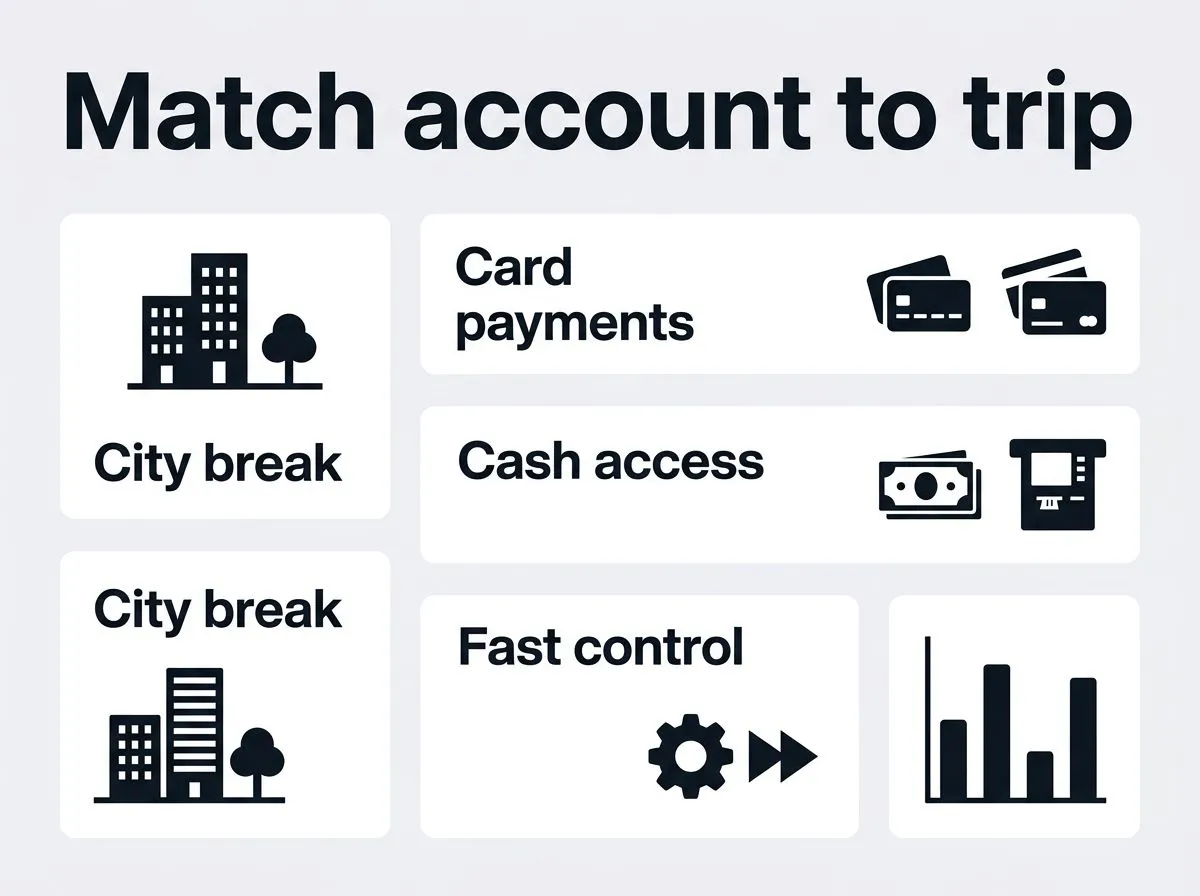
- Choose a basic card-focused account if most of your trip will be card payments in cities, hotels and transport systems, and you do not expect to use much cash.
- Choose a better cash-access setup if you know you will need frequent ATM withdrawals, because the cheapest card on paper may be poor value once withdrawal charges are added.
- Choose an account with strong backup features if you want emergency access, such as a second card, instant card freezing in the app, and simple replacement or support routes if the main card is lost, blocked or skimmed.
- Before you leave, ask the bank about app availability overseas, card replacement timelines, lost-and-stolen reporting, emergency contact numbers and whether notifications work reliably while roaming.
- Use one final rule of thumb: if the account makes it easy to pay, easy to freeze, and easy to recover access in an emergency, it is usually a better travel bank account for South Africans than one that only advertises low fees.
That decision is easier if you match the account to the trip, not to the advert. A city break with hotel bills and card readers everywhere calls for convenience and low friction. A trip with trains, markets and emergency cash needs calls for stronger ATM access and a cleaner backup plan.
The most useful feature in practice is not a shiny benefit, but fast control. If you can freeze the card in the app, get a second card, and contact support without a long wait, you reduce the damage from theft, skimming or a failed payment abroad.
The final choice comes down to three decisions. First, whether your spending will be mostly card-based or cash-heavy, because that changes the importance of ATM charges. Second, whether you want a simple current account or a travel-focused setup, because that changes the level of control you get. Third, whether your bank’s overseas support is good enough for an emergency, because that is what matters when the trip doesn’t go to plan.
Frequently asked questions
Can I use a South African bank card overseas without telling the bank first?
Sometimes yes, but you should check with your bank before you travel so the card is not flagged or blocked for unusual activity. That matters even more if you plan to use the card repeatedly abroad, because support, card controls and emergency access are part of what makes a travel account usable when you are away.
Will I be charged if I pay in local currency instead of pounds or rand?
Usually the local currency is the safer choice at the point of sale or ATM, because dynamic currency conversion often adds a poor exchange rate. The real cost is not just the visible fee, but the conversion rate and any bank mark-up, so choose the local currency unless your bank has clearly shown you a better total price.
What should I do if my card is lost or skimmed while I’m away?
Freeze the card in the banking app if you can, then contact the bank’s lost and stolen line immediately and use a backup payment method. The article also stresses having a second card and knowing your support routes before you leave, because fast control matters more than a low account fee in an emergency.
Are contactless payments widely accepted abroad?
Often yes in cities and larger shops, but you should still carry a second card and some cash for smaller merchants or transport. The practical test is whether your account gives you clean backup access, because even a card-friendly trip can still run into places where cash is the only easy option.