
How to compare South African store card fees
Store card fees are the extra charges tied to a store-branded credit account, and they matter because the advertised discount is only part of what you’ll pay. To compare them properly, check the activation or issue fee, the monthly service fee, late-payment and replacement charges, then add the interest you’d pay if you don’t clear the balance in full.
Key takeaways
- Count the monthly service fee plus any activation charge before you look at the discount, because those costs start on day 1.
- Check the latest National Credit Act limits and official notices, not the shop poster, before you sign.
- If you carry a balance for more than 1 month, interest can erase a store discount fast.
- Late-payment and replacement-card charges can turn a small purchase into a much pricier one.
- Only compare cards using the disclosure sheet, the schedule of charges and the full credit agreement.
What store card fees usually include
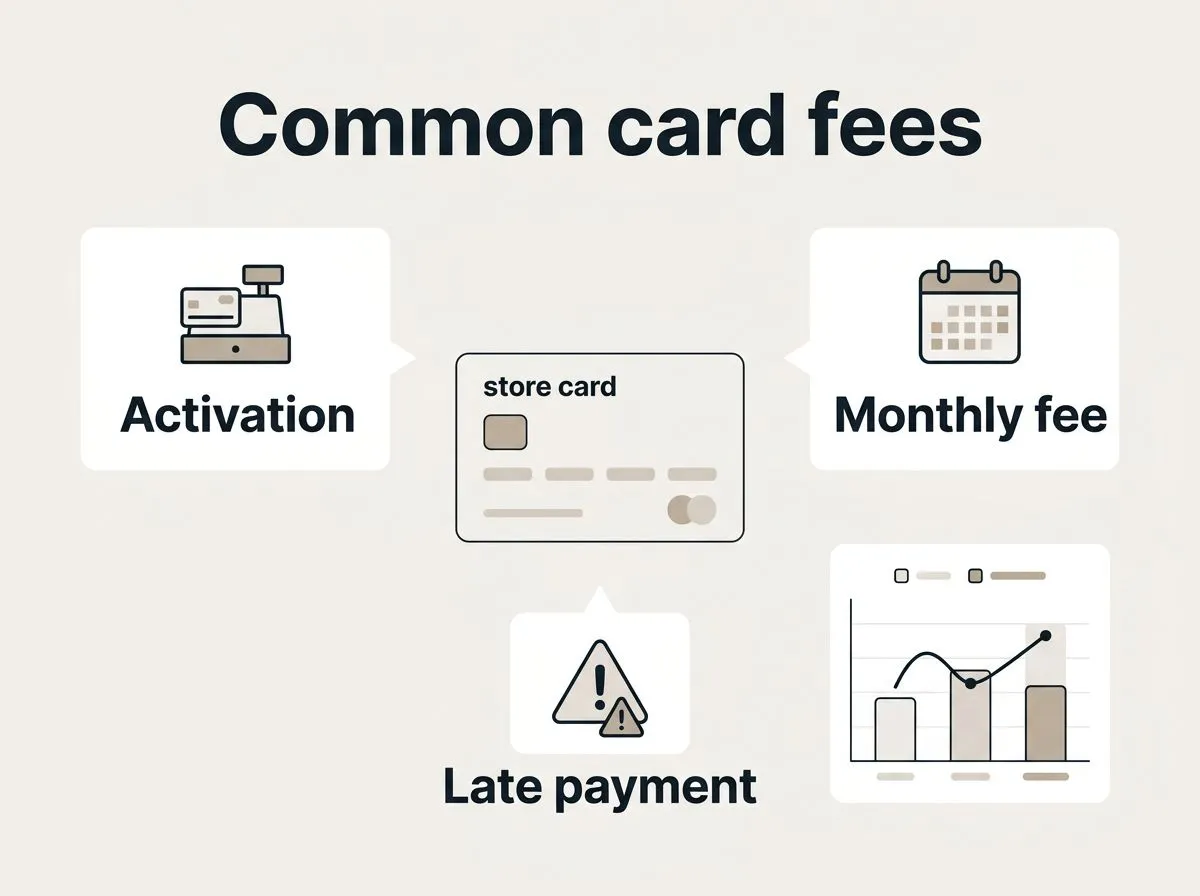
- An activation or issuance fee, which may appear as the price of the card when you take it out at the till.
- A monthly service or account fee, which can be charged even if you use the card very little.
- Late-payment charges and replacement-card costs, which are the parts shoppers often miss because they sit in the terms, not the headline offer.
- The fee schedule on the packaging or provider website, which is the only place you can check the full cost before you sign up.
Which rules and limits govern credit fees in South Africa
The National Credit Act No. 34 of 2005 is the starting point, because it sets the legal framework for credit agreements, consumer protection and what a credit provider may charge. In plain terms, the sales pitch is not the source of truth, the written credit terms are.
The fee and interest limits come through regulations under the Act, and the current position is published in official government notices and the Government Gazette on the South African Government site. If you want the live rule, check the latest notice there rather than relying on a leaflet in a shop or a promotion that’s already a month old.
That difference matters because store cards can be sold with a very attractive offer, while the real cost sits in the account terms. A consumer should compare the disclosure sheet, the schedule of charges and the credit agreement itself, not just the savings claim on the poster.
The Consumer Financial Protection Bureau’s guidance on card packaging makes the same practical point for comparison shopping, namely that the package should show the key fees and send you to a website with fuller details, and the same discipline helps here even though South African rules govern the account.
If the store says one thing and the agreement says another, the agreement wins. That is also why regulated names matter: the South African Government and the official Act tell you the legal ceiling, while the provider document tells you the actual fee you’ll pay within that ceiling.
Store card fees versus interest: what the real cost of credit looks like
The real cost of a store card is the monthly fee plus interest if you carry a balance, because both charges keep running after the discount has been spent. Sanlam’s guidance notes that the total cost of credit over the full term is the question to ask, and that’s the right comparison for a store account as well.
A simple example shows why. If a store card has a monthly service fee and you leave even a small balance unpaid, the fee lands first, then interest is added to the outstanding balance. Over several months, the discount on the item can disappear completely, especially if you miss the due date and trigger a late-payment charge as well.
That’s why the useful question is not, ‘How big is the discount?’ It is, ‘What will this cost if I pay it off over the period I can actually afford?’ If the answer is one month and you can clear the balance in full, a store card can be manageable. If the answer stretches over several months, the recurring fee and interest need to be counted before you accept the offer.
There’s one more detail that shoppers often overlook: the reporting and billing cycle can matter as much as the due date. Sanlam points out that the balance reported to SACRAA, the South African Credit and Risk Reporting Association, is the statement balance rather than the due-date balance, so timing your payment changes both the interest you pay and how the account appears on your credit record.
How provider terms differ when you compare store cards side by side
| Provider | Activation or issuance fee | Monthly service fee | Late-payment or replacement charges | Interest rate or pricing note | Useful term to check |
|---|---|---|---|---|---|
| TFG Money Account | Check the opening and account terms | Charged monthly, with notice if changed | Replacement card cost applies if a new card is issued | Interest may be charged on unpaid balances | Whether the service fee can change to annual billing |
| Bash | Not stated in the terms excerpt provided | Monthly service fee must be paid by the due date | Replacement card cost if your card is lost or stolen | Unpaid service fees can be added to the balance and attract interest | What happens if the fee is paid late |
| Sanlam example discussion | Not a product term sheet, so no card fee to compare | Used as a comparison example only | Not applicable | Store-account interest is capped by the National Credit Act framework, with the actual rate depending on profile | Whether the card follows the same rate disclosure format as the interest rate |
The table shows why you can’t compare store cards on headline offers alone. One provider may emphasise a monthly fee, another may make the replacement-card charge the more annoying cost, and the way the interest is described can be just as important as the number itself.
A practical comparison only works if you line up the same fields for each account: opening cost, monthly fee, late-payment cost, replacement cost and the rate note. If one offer hides the fee in a different place, treat that as a warning sign, not a quirk.
The common mistakes shoppers make when chasing store discounts
- Opening a card for one discount without checking whether the monthly fee eats the savings within a few billing cycles.
- Missing the due date and turning a cheap purchase into a larger debt once late charges and interest are added.
- Assuming a low monthly fee automatically makes the account cheaper than a normal credit card, when the real answer depends on how long you carry the balance.
- Skipping the card packaging and online terms, even though those are the places where the fee chart and detailed conditions are listed.
Verification checklist
- Check the card packaging or website fee chart before applying, and confirm that the activation fee, monthly fee and penalty charges are all listed.
- Read the store account agreement, and make sure the due date, late-payment rule and replacement-card charge are stated in writing.
- Verify the legal ceiling in the current Government Gazette or the official National Credit Act notice, and confirm that the advertised charge sits within it.
- Work out the total cost over the period you expect to carry the balance, and only proceed if the savings still exceed fees plus interest.
Frequently asked questions
Where do I find the official store card fee schedule before I apply?
Check the card packaging in store and the provider’s website terms, because those are the places that should show the fee chart before you sign up. If the leaflet or till-side card gives only a headline figure, use it as a pointer to the full online disclosure, not as the final word on cost.
Can a store card charge a fee if I do not use it much?
Yes, a monthly service fee can still apply even when you spend little or nothing, so inactivity does not automatically mean a free account. That is why a store card with a good discount can still cost you money each month unless you close it or the terms clearly say otherwise.
What happens if I pay late on a store card?
Late payment can trigger a penalty charge and interest, which makes the balance more expensive to clear in full. In practice, the missed payment can also affect how the account behaves in the next billing cycle, so the cost of that one slip can run beyond the original due date.
Is a store card always more expensive than a normal credit card?
No, but it can be. The fair comparison is the full cost, including the monthly fee, interest and any penalty charges over the time you expect to carry a balance, because a short-lived discount can be wiped out quickly if repayment takes more than one statement cycle.