How to spot a legit AI startup job in Cape Town
A real AI startup job in Cape Town is usually straightforward to verify, because the company, the role and the hiring process should line up across the advert, the website and professional profiles. If the post feels vague, rushed or money-related, treat it as unsafe until you’ve proved otherwise. This guide shows you how to check the employer, the role and the process before you send anything.
Key takeaways
- A credible advert should name the role, team and location, with a real company website and application route.
- If the company name, domain or LinkedIn profile do not match, pause before sending your CV.
- Early-stage AI roles are most believable when the tasks match the startup’s product and size, not just the buzzwords.
- Never pay to apply or share money-related details in the first contact; that is a hard stop.
- If the role cannot explain what you will do in the first 90 days, treat it as too vague to trust.
What a real AI startup job advert should look like
- A specific job title, team, responsibilities and either a Cape Town location or a clear remote arrangement.
- A named company, a working website and a proper route to apply, not a random email address with no context.
- Requirements that sound like a job, not hype, including tools, skills or experience the role actually needs.
- A description that fits the company’s stage, product and team size, so a tiny startup does not sound like a giant enterprise.
- No fake urgency, no “instant start” fantasy and no buzzword soup that hides what the work is really about.
The strongest sign of a legitimate advert is coherence. If a startup says it builds a data product, the job should point to data work, engineering, product or operations. A post that promises a “high-impact AI role” but never says what you’ll build, who you report to or what success looks like is too thin to trust.
That pattern matters because genuine AI hiring often looks ordinary on the surface. GOV.UK’s vacancy analysis found common AI-related titles such as Data Scientist, Machine Learning Engineer, Python Developer and Computer Vision Engineer, while also noting broader implementer roles that use AI tools in day-to-day work (AI Skills for Life and Work: Job vacancy analysis). If a post uses the language of AI but avoids any concrete title or task, that’s a warning sign, not a selling point.
How to verify the company behind the role
- Open the company website and check the domain, the contact page and the footer details. A proper business usually has the same name on the site, email domain and careers page.
- Search the business name on LinkedIn and read the company profile, employee list and recent posts. The story should be consistent, not a blank shell with one polished post.
- Look for South African registration evidence and an address that matches what the company claims publicly. A real employer should be able to show that it exists as a registered business, not just as a brand name.
- Check whether the founders, recruiters or hiring managers have matching identities across the website, LinkedIn and any recruiting platform. Their names, roles and photos should not shift from one channel to another.
- If the domain, names or addresses do not match, pause. Inconsistency is enough reason to ask for proof before you apply, not after you share your CV.
Use the same standard you’d use for any employer that expects trust from you. A company can have a slick landing page and still be difficult to verify, so the useful question is whether the web presence and the public records tell one story. If they don’t, don’t let a polished pitch stand in for evidence.
There’s a simple practical rule here: match the company’s public identity across channels before you match your skills to the job. If the business name on LinkedIn differs from the name on the advert, or the email domain points somewhere unrelated, the burden is on the employer to explain the gap. Until then, the role isn’t credible enough to pursue.
Which AI startup roles are credible at an early-stage company
| Role type | Typical responsibilities | Likely experience level | Red flags in the description | What to confirm before applying |
|---|---|---|---|---|
| Machine learning engineer | Model implementation, deployment, testing and collaboration with product or data teams | Usually intermediate to experienced | Claims about “building AGI” with no tooling, team or product details | Ask what models, stack and deployment environment the team actually uses |
| Data scientist | Analysis, feature work, experimentation and support for product decisions | Often intermediate, sometimes entry-level if the company has a mentoring structure | A title that promises advanced research but no data source, product or business problem | Check whether the role is about analysis, experimentation or production support |
| Python developer | Scripting, automation, backend work or internal tools that support AI products | Entry-level to intermediate depending on the stack | A vague “AI developer” title with no coding tasks or repository evidence | Look for the codebase, framework and whether the work is product-facing |
| AI product or operations associate | Workflow support, prompt testing, annotation oversight or user feedback handling | Entry-level to early-career | A role that sounds senior but has no clear deliverables or reporting line | Ask how success is measured in the first 90 days |
A credible early-stage role is usually narrow, because startups hire to solve one problem first. If the advert reads like it wants a researcher, an engineer, a product manager and a sales person in one seat, the company may be using AI as decoration rather than as a real product focus. That often shows up when the title sounds grand but the responsibilities stay generic.
The practical test is simple: can you explain what the job makes you do on a Monday morning? If you can’t turn the advert into a concrete workday, the hiring team probably hasn’t either. Good startups know the answer. Weak ones hide behind ambition language.
What a legitimate hiring process may ask for, and what it should never ask you to do
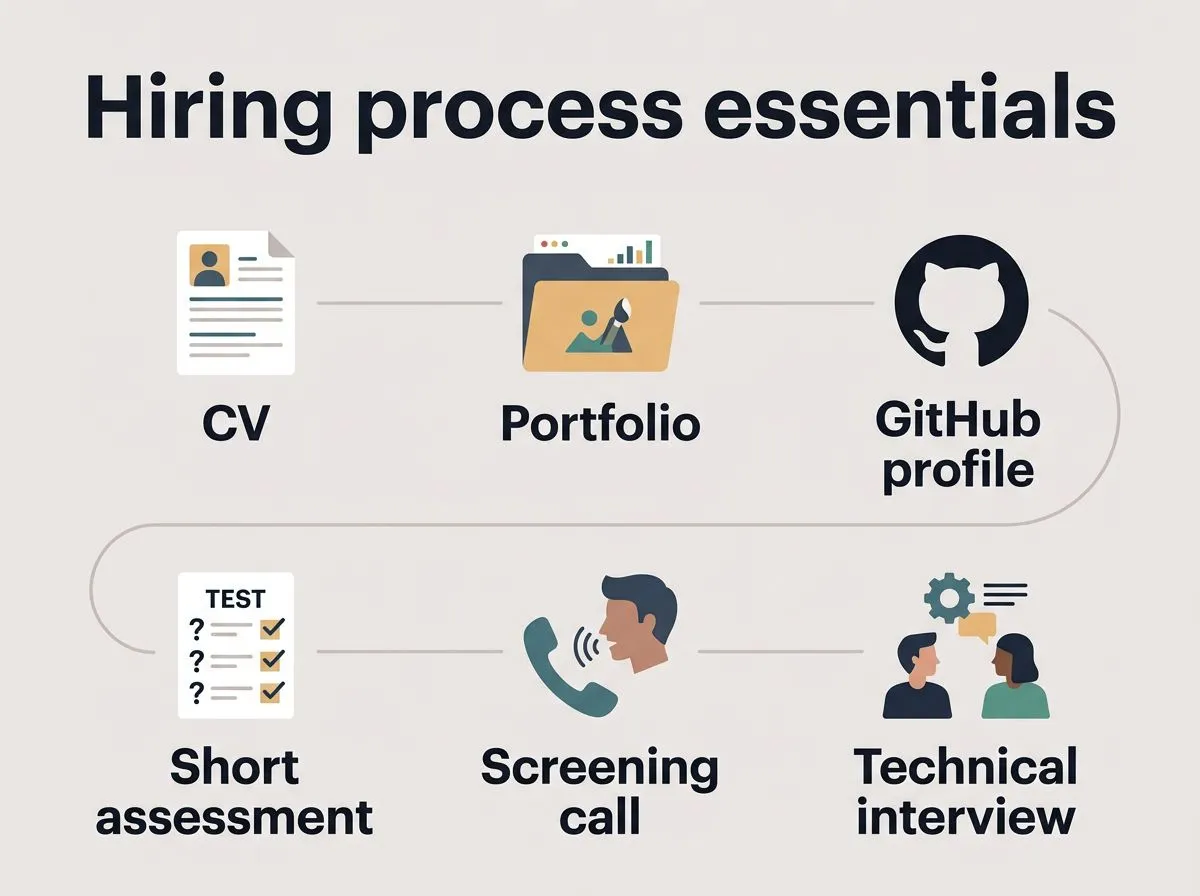
- Normal asks: a CV, a portfolio, a GitHub profile, a short assessment, a screening call or a technical interview.
- Normal early-stage evidence: a short explanation of projects you have built, a link to code or a sample of analysis work.
- Never normal at the start: banking details, identity documents without a clear reason, or any request that feels larger than a first-stage application.
- Never normal in a real hiring process: paying a fee, buying equipment up front, or paying for training to get the job.
- Never normal under pressure: being told to decide immediately, communicate only on a private messaging app, or keep the process secret from others.
A legitimate employer may ask for enough information to assess your fit, but it shouldn’t jump straight to sensitive data or money. Wellfound says it is built for startup hiring and emphasises direct contact with the people doing the actual hiring, which is the sort of structure that makes a process easier to inspect (Wellfound). That doesn’t make every listing perfect, but it does show what an accountable process looks like: visible roles, visible people and a traceable application path.
Some companies also publish explicit anti-scam warnings on their own careers pages. United Rentals says it will never ask applicants to pay fees during the hiring process and will never ask for a Social Security number or date of birth during the application process, while Innnodata says it will never ask for payment (United Rentals Careers, Innodata Inc.). The exact identity checks differ by country, but the principle is the same: early hiring shouldn’t turn into a request for money or unnecessary personal data.
If a process jumps to payment, secrecy or urgency, stop responding and keep your documents to yourself. A serious employer can wait while you verify them. A fake one often can’t.
How to judge whether the role and company presence are credible enough to pursue
A role is credible enough to pursue when the advert, the website and the hiring trail tell the same story without gaps. If the company’s public profile looks stable, the role matches its actual product and stage, and the process gives you time to ask questions, you can apply with a reasonable degree of confidence. If those pieces don’t line up, treat the job as unproven until the employer clears up the mismatch.
This is where context matters. A young AI startup can still be real even if it has a small footprint, because early businesses often have lean websites and modest LinkedIn activity. But it should still be able to explain what it builds, who is hiring, where it’s based and how applicants should proceed. If you get vague answers to those basics, the problem isn’t the startup stage, it’s the credibility gap.
A useful decision rule is this: apply when the facts match, ask for proof when one detail is missing, and walk away when two or more details conflict. That keeps you from missing good opportunities while still protecting your time, documents and confidence. It also stops you from treating a glossy advert as if it were evidence.
If you want more context on how genuine AI hiring is being shaped, GOV.UK’s AI materials show that governments are actively trying to feed entry-level routes and skills pipelines into AI work, including bootcamps and training support (Entry-level jobs support, AI bootcamps and tech training, AI to power national renewal). That tells you something important: real AI hiring usually has a visible skills pathway behind it, not just a flashy promise at the front end.
The safest approach is to treat every application as a small verification exercise. If the company can pass the checks, the role is worth your time. If it can’t, you’ve already learned enough without handing over anything useful.
Frequently asked questions
Can a startup ask for a portfolio or GitHub before the first interview?
Yes. For AI and software roles, that is normal, especially if the work is technical. What should raise concern is a request for money, bank details or identity documents far too early without a clear, legitimate reason.
What if the company says it is ‘stealth mode’ and has no website?
A stealth startup can still be real, but you should look for other solid signals, including named people, a traceable business registration and a role description that fits the company’s stage and product. If the brand is hidden but the email domain, LinkedIn presence and hiring contact all still align, that is more credible than a completely opaque setup. If everything is vague or rushed, treat it as high risk.
Is a LinkedIn page enough to prove the employer is real?
No. A LinkedIn page helps, but it is only one check, not proof on its own. You still need matching company details, a working website or domain, and evidence that the business and the people involved are consistent across channels. If the name on LinkedIn differs from the advert or the email domain points somewhere unrelated, pause and verify.
Should I pay for equipment, onboarding or a skills test?
No, not before you have independently verified the employer and have a legitimate offer in writing. A genuine employer normally does not make applicants pay to be considered or hired, and you should be especially wary if payment is linked to urgency, secrecy or a promise of immediate start.