
How to spot a legit remote data entry job in South Africa
A legitimate remote data entry job in South Africa is one you can verify through the employer’s own channels, with a named company, a specific role, sensible duties and no request for money upfront. If the advert comes through WhatsApp, asks for crypto or promises easy cash for very little work, treat it as unverified until the company proves otherwise.
Key takeaways
- A real advert should name the employer, the role and the application route, with no request for money upfront.
- Treat WhatsApp, Telegram or Signal outreach as unverified until the same vacancy appears on the employer’s official channels.
- If a recruiter asks for fees, crypto or your banking details too early, stop and verify before sending anything.
- Legit remote data entry roles usually describe duties, hours and oversight clearly, not as ‘simple online work’.
- Use the company website, careers page and business email to confirm the vacancy before you share your CV or ID.
What a real remote data entry vacancy looks like
- A real listing usually names the employer, gives a specific job title and describes the duties clearly, not with vague phrases like ‘simple online work’.
- Legitimate adverts normally explain the application route, the level of experience needed and whether the role is fully remote, hybrid or tied to certain hours.
- Remote does not mean loose or unstructured, so expect normal oversight such as fixed shifts, check-ins or occasional meetings.
- This guide covers remote data entry roles for South Africa, not generic freelance typing gigs or unrelated online tasks.
That basic shape matters because fake adverts are vague for a reason. A real vacancy usually reads like work, not bait. From the advert alone, you should be able to answer three things: who is hiring, what the job actually involves, and how you’re supposed to apply.
The safest way to judge an advert is to compare it with normal job listings in the same market. On platforms such as DailyRemote and Glassdoor, data entry roles are usually tied to a company, a working pattern and duties that sound operational rather than mysterious. If the wording is muddy or oversells speed and earnings, that already tells you something.
Common scam warning signs and payment traps
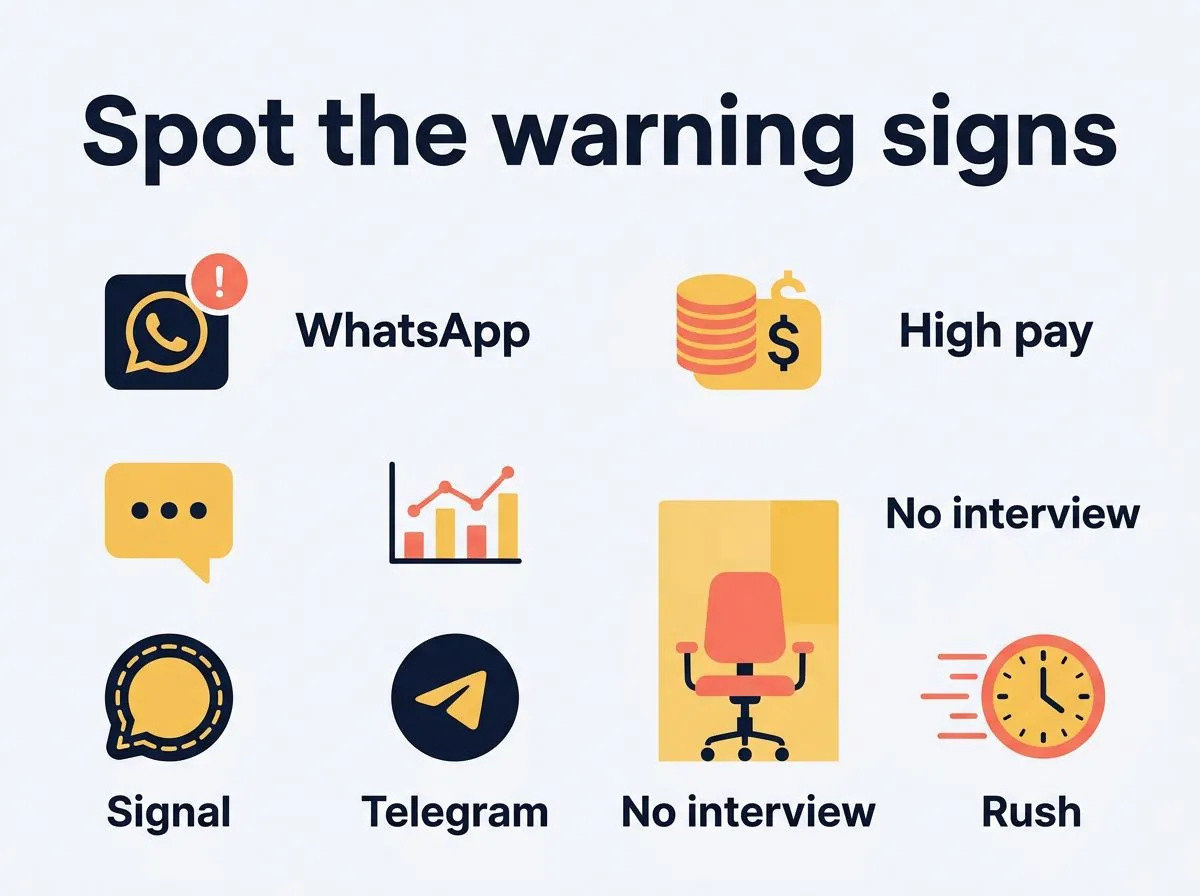
- Unexpected contact through WhatsApp, Signal or Telegram should be treated as unverified until the company and vacancy are checked elsewhere.
- Promises of high pay for very little effort, no interview, or an instant start are classic pressure signals rather than proof of a real vacancy.
- Requests to pay a fee, top up an account, buy crypto, buy equipment through the recruiter, or recruit other people for rewards are payment traps.
- Urgency, threats, and requests for passport, ID or banking details too early are warning signs, especially if the recruiter avoids answering direct questions.
These traps are designed to get you acting before you think. Scamwatch flags the same pattern: a surprise message, big earnings for little effort, a rushed hiring process, and a request to add your own money or cryptocurrency to complete tasks. Once the conversation turns to payments, the burden is on the recruiter to prove legitimacy, not on you to keep going.
A common beginner mistake is to take a polished chat thread as proof. It isn’t. Anyone can copy a logo, write a convincing message and claim to be from a real company. The question that matters is whether the same role appears on the company’s official channels and whether the contact route matches what the employer normally uses.
How to verify the employer, recruiter and vacancy
- Check the employer’s official website and careers page for the same role, wording and contact details.
- Look for a traceable company name, a business email address and a consistent application route that does not change from one message to the next.
- Compare the vacancy with other legitimate postings to see whether the job title, location, pay range and duties match up.
- If a recruiter contacts you first, confirm their name and role on the company’s official channels before replying with anything sensitive.
- If the advert cannot be matched to the employer’s own channels, treat it as unverified and stop there.
This check is quicker than most people think. A genuine employer usually leaves a trail you can follow, a careers page, a named recruiter and a process that doesn’t change every time you ask a question. If the posting is real, the employer should be able to show you where it lives on their own site, not only in a chat message.
Civil Service Jobs is a useful example of what a proper application trail looks like. One vacancy shows the employer, the job title, the number of jobs available and the process information in one place, while another says the post is open to remote workers but still requires in-person meetings at named sites. That’s the sort of detail scammers often avoid, because it’s easy to check and hard to fake consistently. Civil Service Jobs
Use the same discipline if someone says they’re a recruiter. Ask for the person’s full name, role and company email, then confirm those details on the company’s own site or official careers page before you share a CV or ID. If the name disappears, the email changes, or the person pushes you to move the chat elsewhere, stop.
Typical duties, pay arrangements and working conditions
| Duties | Pay arrangement | Working hours | Working setup | Experience level |
|---|---|---|---|---|
| Typing and updating records, spreadsheet maintenance, document prep, inbox or file organisation | Often hourly or salaried, sometimes shown as a monthly range in job boards | Fixed shifts or set availability are common, even in remote roles | Usually home-based with occasional meetings or check-ins | Entry-level roles exist, but many employers want some admin or spreadsheet experience |
| Data entry is rarely a one-task job; it often includes admin support, file management and basic recordkeeping | If the advert promises unusually high earnings for simple typing, treat that as a warning sign | Remote work can still mean deadlines, reporting and team availability | If the role says fully remote but later adds office attendance, that is a detail to verify early | A clean CV, strong accuracy and decent computer skills matter more than exaggerated claims |
The main thing to understand is that data entry is usually part of wider admin work. On DailyRemote, examples for South Africa include administrative support, digital filing, spreadsheet maintenance and invoicing, which is much closer to office operations than mindless typing. That matters because a serious employer will test accuracy, not speed alone. DailyRemote
Pay tends to follow the structure of the role, not the fantasy in the advert. Glassdoor’s South Africa data entry listings show that the market is active, but the real question is not simply whether jobs exist. It’s whether the duties, hours and compensation line up with the level of responsibility the employer is asking for. Glassdoor
Safe application, payment and scam-reporting steps in South Africa
- Apply only through official employer channels and keep a copy of the advert, emails and message history.
- Never pay to get hired, to access tasks or to release earnings, no matter how small the amount seems.
- Share the minimum personal information needed at first and hold back ID scans, bank details and a full address until the employer is verified.
- If you suspect fraud, report it to South African policing or cybercrime channels and also warn the platform used to contact you.
- Stop communicating the moment the conversation turns to fees, secrecy, recruitment rewards or pressure to move off normal channels.
A safe application process is boring, and that’s exactly what you want. Real employers don’t need you to pay a clearance fee, buy crypto, or send sensitive documents before basic checks are done. If the request is legitimate, the recruiter can explain why the information is needed and how it will be stored.
Keep your first reply short. A line like, “Please send the company name, official careers link and job reference, then I will review the role,” is enough to test whether the contact is real. If they answer with pressure instead of details, you already have your answer.
For job-seekers in South Africa, the practical rule is simple: verify the employer first, then the recruiter, then the vacancy, and only after that think about documents or availability. If any one of those checks fails, walk away. Real remote data entry work can be found, but it rarely asks you to trust a stranger before you’ve seen the employer prove the role exists.
Frequently asked questions
Can a remote data entry job in South Africa be legitimate if the recruiter contacts me on WhatsApp?
Yes, but only as an unverified lead until you confirm the company, the recruiter and the vacancy through official channels. WhatsApp outreach is not proof of fraud on its own, but it is a common scam route, especially if the message pushes you towards crypto, secrecy or instant start.
Should I ever pay a fee, deposit or training cost to start remote data entry work?
No. A genuine employer should not ask you to pay to be hired, to access tasks or to receive earnings. If the conversation turns to a fee, equipment purchase or any kind of deposit, treat that as a payment trap rather than a normal hiring step.
What documents should I avoid sending before I have verified the job?
Do not send passport scans, ID copies, bank details or your full address until you have checked the employer and the vacancy against official sources. At the start, share only the minimum needed to keep the process moving, and wait until the role is properly verified before sending anything sensitive.
What if the job advert says remote work but mentions occasional office meetings?
That can still be genuine. Some remote roles are hybrid, with fixed shifts, check-ins or periodic in-person meetings, so the key is to confirm the location details and travel expectations before you apply. If the advert says fully remote but later adds office attendance, get that clarified in writing first.