
Remote work jobs for South Africans: where the real openings are
Remote work jobs for South Africans are real openings you can do from home, or from any place with a stable internet connection, but the best ones come through recognised job boards, employer career pages and agencies with clear hiring terms. Check whether the role is open to South Africa, whether you’re being hired as an employee or contractor, and whether the pay and tax setup actually works before you apply.
Key takeaways
- Use employer career pages, LinkedIn Jobs and specialist boards first, because those are where legitimate remote roles are most often posted.
- Customer support, software, marketing and operations are the 4 role families that hire remotely most often.
- Check 3 things before applying, whether South Africa is eligible, whether you are an employee or contractor, and how payment is handled.
- Reject adverts that hide the employer name, promise vague hours or push you to message on WhatsApp before a formal application.
- If a role mentions UK-only, EU-only or a required time zone, treat that as a hard filter, not a soft preference.
Where legitimate remote roles are actually posted
| Source type | Best for | Signals of legitimacy | Common limits for South African applicants |
|---|---|---|---|
| Employer career pages | Direct hires, especially established companies | Real company name, matching job title, consistent branding, application through the company domain | Many roles state UK-only, EU-only or a specific time zone |
| LinkedIn Jobs | Broad search across industries and recruiters | Named employer, active recruiter profile, detailed duties, recent posting date | Some listings are recycled or duplicated, and location filters can be loose |
| Indeed | Volume and quick scanning | Full job description, named employer, salary or range, normal application flow | Quality varies, so you must check the employer outside the advert |
| Glassdoor | Company research alongside the vacancy | Employer reviews, salary clues and job details that align with the company site | Listings can be thin, so treat it as a check, not proof |
| Wellfound | Start-ups and product companies | Clear equity or funding context, named team, specific function | Start-ups often want overlap with Europe or North America |
| Remote OK | Remote-first tech and support roles | Remote-specific role, explicit location wording, clear application path | Some jobs are contractor-only and may exclude certain countries |
| We Work Remotely | Remote-first roles across tech and operations | Specialist remote board, direct employer posts, role written for distributed teams | A lot of roles expect overlap with US or UK hours |
| Otta | Curated UK tech and commercial jobs | Structured role pages, employer profile, location detail | Many jobs are UK-centred, so read the eligibility line carefully |
| Recruitment agencies | Contract and permanent placements | Named consultant, real firm website, written briefing on the vacancy | Agencies may only submit candidates eligible to work in a specific market |
| Payment platforms mentioned in adverts, such as Wise or Mukuru | Cross-border pay in certain contractor setups | The advert explains how pay is sent and who covers fees | A payment method is not a hiring signal by itself, only a practical detail |
The strongest sign is not the platform, it’s how clear the employer is. A genuine vacancy names the hiring company, explains what the role involves, and says whether it’s remote-first, hybrid or remote within a region. If the advert reads like ten others, expects you to work any hours and hides the company name until late, treat it as weak until it proves otherwise.
For South Africans, geography is usually the main limit, not skill. A UK company may like your experience and still restrict the role to candidates already entitled to work in the UK, or to contractors in countries where its payroll provider can pay cleanly. That’s why the next section matters more than the headline words “remote” or “work from home”.
Roles that commonly hire remotely
- Customer support and customer success roles, especially shift-based and multi-channel support
- Software, product and QA roles, including developers, testers and product operations
- Marketing, content and design roles, particularly performance marketing, copywriting, SEO and visual design
- Admin, operations and project coordination roles, including virtual assistant, scheduling and delivery support
Customer support is often the easiest entry point because employers can measure output quickly. They want calm written English, decent typing speed and the ability to cover early or late shifts when the customer base is in another time zone. If you’ve handled tickets, live chat or complaint escalation, say so plainly on your CV.
A strong CV line for this lane looks like: “Handled 40 to 60 daily support tickets in Zendesk, resolved billing and login queries, and kept first response times below team target.” That tells the hiring manager which tools you used and what result you delivered. Empty phrases like “excellent communication skills” don’t do the job.
Software, QA and product work are common remote families because the deliverables are digital. Employers care about your stack, your test coverage, your version control habits and whether you can explain bugs or trade-offs clearly in writing. For these roles, a short portfolio or GitHub link often beats a long personal statement.
Marketing, content and design roles travel well too, but they’re more selective than people expect. A hiring manager wants proof, such as campaigns launched, pages ranked, conversion lifts, briefs completed or a clean portfolio with live links. If the advert asks for copy, SEO, Figma, GA4 or HubSpot, mirror those exact tools in your CV where you’ve used them.
Admin and coordination roles are quieter, but plentiful. They suit people who can manage calendars, chase deadlines, format documents, keep CRM entries clean and protect a manager from small mistakes that waste time. The best evidence here is not a slogan about being organised, it’s a line showing that you’ve supported schedules, invoices or project trackers without things slipping.
How to spot roles open to South African applicants
The wording in the advert usually tells you the answer if you read it carefully. “Remote” often means the job can be done from anywhere, but “remote in the UK” or “UK-only” means the employer expects you to be based there. “EMEA” usually means Europe, the Middle East and Africa, while “global” is the broadest signal, although even global roles can still exclude certain countries.
What employer setup is behind the advert
The employer setup decides whether you’re being hired through a local entity, an employer of record, or as a contractor. If the company says it uses an employer of record, that usually means a third party handles employment in the worker’s country, but it doesn’t guarantee every country is included. If the role is contractor-based, the company is buying services rather than employing you, so the paperwork, benefits and tax treatment are different.
Time zone overlap matters almost as much as nationality. A South African applicant who can work UK business hours will often beat someone technically stronger but unavailable during team meetings, customer handovers or live support shifts. English skill matters too, but not just general fluency, the employer is usually looking for crisp written English, quick understanding of instructions and the ability to keep tone consistent with customers or internal teams.
Payment language also gives away eligibility. If the advert says payment in pounds through payroll, it points to employment or a formal payroll arrangement; if it says invoices in USD, GBP or EUR, it’s more likely a contractor setup. When the ad names Wise or Mukuru in the payment section, that is usually about cross-border transfers, not an automatic sign that the job is open to South Africans.
A simple test helps: if the posting states the region, the contract type and the pay method, it’s probably a real vacancy worth pursuing. If it only says “fully remote” and never explains where the worker sits, ask before spending time on tests or interviews. The answer should be specific enough that you can tell whether your location is acceptable without guessing.
Contract, tax and payment questions to check before you accept
You should confirm the contract type first, because employee and contractor setups create different obligations and protections. Ask one direct question: “Will I be engaged as an employee or an independent contractor?” If the recruiter can’t answer clearly, that’s a problem. Once you know the setup, the rest of the paperwork makes sense.
- Confirm whether you are being hired as an employee or an independent contractor, because the obligations and protections differ.
- Check who pays you, in which currency, and through which platform, payroll system or bank transfer.
- Ask how South African tax residency and any UK employment or payroll rules affect the setup before you sign.
- Confirm notice period, intellectual property clauses, confidentiality obligations and whether equipment or internet costs are supported.
On the tax side, the South African Revenue Service is the authority you need to keep in mind if you remain tax resident in South Africa.
UK employers also have their own rules around right to work, payroll and engagement type, and HM Government right to work checks apply when a company needs to confirm someone’s entitlement to work in the UK.
If the recruiter mentions UK Visas and Immigration, that usually means the role is being filtered through UK immigration and work authorisation requirements, so don’t assume a remote setup bypasses those rules.
Money movement is practical, not decorative. You need to know whether you’ll be paid in GBP, ZAR or another currency, how often payment lands, whether exchange costs are passed on to you, and whether the company pays through payroll, an invoicing system or a global contractor platform. Even a small point, like who covers transfer fees, can make a real difference to what you keep.
The contract itself needs a close read. Pay attention to the intellectual property wording if you write code, copy or designs, because some agreements hand everything you create over to the company straight away. Check the notice period and the equipment terms too. If the employer expects you to provide your own laptop, backup internet and workspace, you need to know that before you say yes, not after your first deadline.
Red flags in remote job adverts
- Upfront fees, training payments or any request that you pay to apply or start
- Vague company identity, copied job text or a posting that does not name a real hiring employer
- Interviews handled only by chat, with pressure to accept quickly or before proper verification
- Requests for bank details, ID scans, passport images or login credentials too early in the process
A real employer doesn’t ask you to pay to join. If an advert wants money for training, processing, background checks or equipment before you have a signed offer from a verifiable company, stop there. Legitimate employers may reimburse equipment or provide it directly, but they don’t make payment a condition of employment.
The company identity should survive a quick external check. Search the employer name, compare the job description with the company website, and see whether the role appears on LinkedIn Jobs, Indeed, Glassdoor, Wellfound, Remote OK, We Work Remotely or Otta with the same title and location. If the text looks copied, clashes with other details, or leaves out the company altogether, that’s not a minor slip. It’s a reason to walk away.
Be careful with document requests. A legitimate recruiter may eventually ask for ID verification, but not before you know who you’re dealing with and why they need it. Never hand over passwords, banking logins, or full document scans because of a chat message from someone who hasn’t been verified through the company’s own domain or a recognised recruitment process.
The safest habit is to slow things down as soon as anything feels rushed. Scams depend on urgency, especially with remote work, because applicants expect online hiring to move quickly. If the job is genuine, a recruiter can wait long enough for you to confirm the company, the contract and the payment route.
Verification checklist
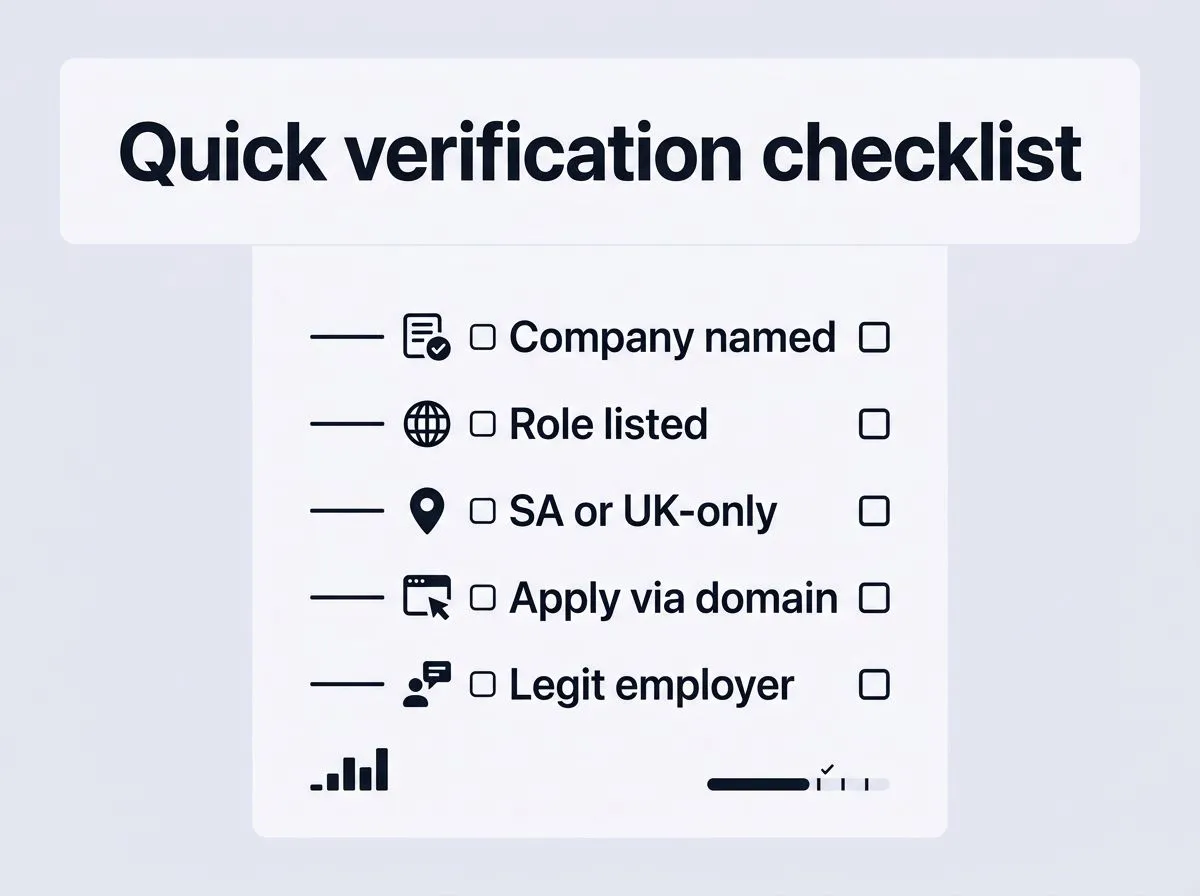
- The advert must name the hiring company and show the role on the company website or a matching job board listing.
- The posting must state whether the role is open to South Africa, UK-only, EMEA or global, and the wording must match your location.
- The recruiter must confirm employee or contractor status in writing, with the pay currency and payment route stated clearly.
- The contract must spell out notice, IP ownership, confidentiality and equipment responsibility before you sign.
Frequently asked questions
Can a South African work remotely for a UK company without a UK visa?
Sometimes, yes, if you are hired as an overseas contractor and work from South Africa rather than being employed onto a UK payroll. The moment the role requires you to work physically in the UK, or the company wants you on its UK payroll, right-to-work and visa rules come back into play. The employer also needs a payment setup it can run cleanly for your country.
Do remote job ads that say "UK time zone" rule out South African applicants?
No, but they do narrow the field. A South African can still be a fit if they can overlap UK business hours for meetings, handovers or support shifts, but that wording usually filters for availability rather than nationality. If the advert also says UK-only, then the location limit is usually stricter.
Should the contract say employee or contractor?
It should match the real working relationship, not the label that sounds more convenient. If you are expected to keep set hours, follow close supervision and use company processes like staff, employee terms are more likely; if you invoice, control how the work is done and supply services independently, contractor terms are more common. The article’s key check is to get that status confirmed in writing before you sign.
What payment method is safest for cross-border remote work?
A traceable business payment method linked to the contract is the safest route. Bank transfer, payroll systems and platforms such as Wise or Mukuru can all be used, but the right choice depends on whether you are an employee or a contractor and which currency you are paid in. What matters most is that the advert explains how the money is sent and who covers the fees.