
What South Africans should know about salary advance apps
If you’re short of cash before payday, a salary advance app can help, but only if you know whether it is wage access or regulated credit. Wage access is usually limited to money you’ve already earned; credit adds cost and repayment terms, so the first job is to check which one the product actually is.
Key takeaways
- A salary advance can be useful for a 7-day cash gap, but only if next payday clears the full deduction.
- Some products are wage access, others are credit, so the fee structure decides the real cost.
- Check whether repayment is automatic on payday before you use the app, because missed wages can still trigger deductions.
- If your income is irregular, you may be declined even when the app looks simple to join.
What salary advance apps are, and how they differ from loans
A salary advance app gives you part of the money you’ve already earned before payday, while a loan gives you new borrowed money that has to be repaid later, with extra cost. The practical test is how repayment works: payroll deduction, a bank debit, or a credit agreement. That difference matters, because the fee structure and the legal treatment can all shift depending on how the product is set up.
In practice, some salary advances are linked to an employer’s payroll system, while others sit inside a banking or mobile money partnership. Maya on Money notes that South African employers have been using salary advance solutions for employees for several years, which shows the model isn’t new even if the branding feels modern. Maya on Money
The label on the app doesn’t settle the issue on its own. A product called an advance can still behave like credit if it charges fees or interest, checks affordability, and collects repayment through a linked bank account or payroll deduction instead of simply paying out wages you’ve already accrued.
That distinction is the first filter for a buyer. If you need bridge cash for a few days and can clear the deduction on the next salary run, an advance may be practical. If the shortfall is structural, a loan, a budget fix or a payment plan is usually the better call, because repeated advances can leave the next paycheque short again.
How salary advances are calculated, accessed and repaid
| Advance size or cap | Access channel and payout speed | Repayment trigger and timing | Whether the employer or payroll system must participate | Typical fees or charges | Common eligibility checks |
|---|---|---|---|---|---|
| Usually a capped share of earned pay, often limited by the provider’s own rules | App or employer platform, then paid into a linked bank account or wallet, sometimes within minutes | Automatically deducted on the next payday or from the next salary flow | Often yes for payroll-linked products, but not always for bank or mobile-backed products | May include a flat fee, service fee, initiation fee or interest-style charge | Employment status, salary history, active bank account and identity verification |
| The cap is what stops the advance from swallowing the full paycheck | The quicker the payout, the less time there is to change your mind | If repayment is fixed to payday, missed or delayed wages can create stress | Where the employer is involved, payroll rules matter as much as app rules | The headline fee is less important than the total amount taken back | Some products also look at whether your salary is paid through the platform itself |
The practical point is straightforward: the amount is usually linked to earned wages, the money is released through a digital channel, and repayment happens automatically when salary lands. For example, if you take £100 early and £100 is deducted on payday, your next paycheque is £100 lighter. That automation is handy, but it also leaves you with less room to adjust if another bill turns up before payday.
Products sold through telecom or wallet ecosystems can look different from employer payroll advances, yet the repayment logic often ends up much the same. XtraCash says its Vodapay Cash Advance is a digitally enabled loan product with initiation fees, daily interest and service fees, and recovery from the bank account linked to the card you confirmed when you accepted the offer. XtraCash
That’s why you should open the fee table, not just the marketing banner. A quick payout is useful, but speed doesn’t make the cash cheaper, and it doesn’t remove the repayment risk if your next salary is already spoken for elsewhere.
Fees, limits, eligibility and South African consumer protections
The total cost of a salary advance matters more than the headline amount because small charges can build quickly on a one-paycycle product. In South Africa, you may see a flat service fee, an initiation fee, a daily charge, or something that looks like interest even if the seller avoids calling it a loan.
Eligibility usually starts with a stable salary flow. Providers often want proof of regular employment, a bank account that receives wages, and access to your payroll or banking data so they can set a safe cap and collect repayment. If your income is irregular, or if your salary doesn’t pass through a participating system, you may be declined even if the app looks easy to use.
The regulatory question is whether the product is merely an advance on wages or whether it is really credit under the National Credit Act 34 of 2005. If the structure involves borrowing, fees for deferral, or repayment terms that go beyond a simple payment of earned wages, the National Credit Regulator may have a role. The name on the screen matters less than the legal mechanics underneath it.
That’s also why consumers should keep an eye on the terms and conditions rather than relying on the product category. If the app is extending credit, the usual consumer-credit protections and disclosure rules become relevant. If it is only advancing money already earned through payroll, the protections may sit more in employment and payment administration than in classic credit law.
Tax and payroll admin can matter too. SARS says most salary earners are not provisional taxpayers if they have no other sources of income, so a normal wage earner using a salary advance usually does not become a provisional taxpayer just because they use a cash-advance product. If you have other income sources or unusual deductions, check your own tax position. SARS
The real danger is the repeat cycle. If you take an advance every month, the next payday starts lower, which can push you into another advance just to cover the gap. That’s how a small liquidity problem turns into a rolling deduction problem, and why salary advances make sense only for short, temporary cashflow strain, not for ongoing overspending.
When a salary advance makes sense
A salary advance makes sense when the shortfall is one-off, the repayment date is certain, and the fee is lower than the consequence of missing a payment elsewhere. It’s a bridge, not a financing strategy.
When it does not
It does not make sense when you’re already relying on the next pay cheque to cover normal living costs, because the deduction simply shifts the problem forward. In that case, the issue isn’t timing, it’s affordability.
What South Africans should check before using one
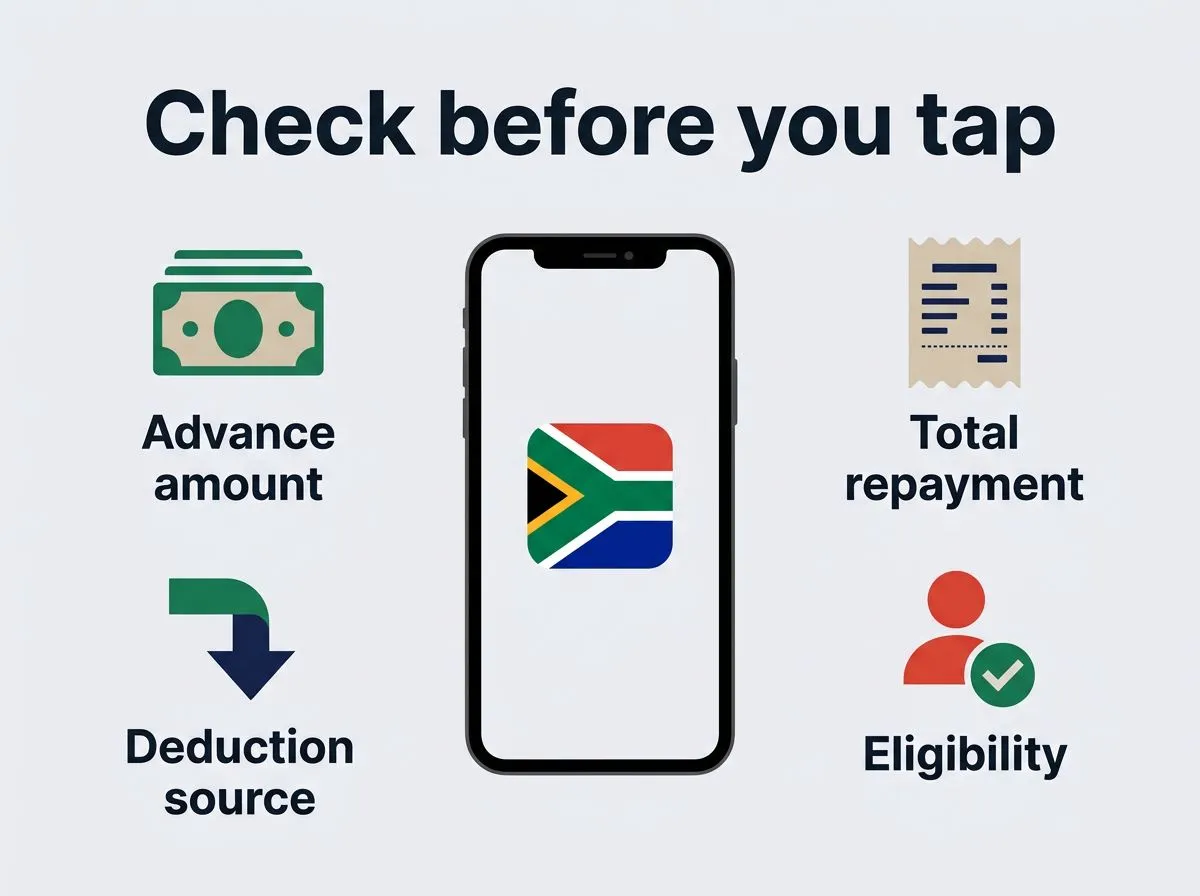
South Africans should check four things before tapping a salary advance app: what is being advanced, how much the total repayment is, where the deduction comes from, and whether the product sits inside credit law or payroll administration. That gives you the real cost and the real risk, not just the app’s promise of instant cash.
- Read the fee table and add up the full repayment, including any service or initiation charge.
- Check whether repayment comes from payroll, a bank account, or a wallet linked to your salary.
- Confirm whether your employer has to participate, because that affects speed and control.
- If the product looks like credit, read the National Credit Act terms instead of assuming it is just an advance.
What to do next
- Look at your next payday and work out whether the advance would leave enough cash for rent, transport and food.
- Open the product’s fee disclosure and compare the total repayment, not just the amount you receive.
- Check whether your employer or payroll system must approve the advance.
- If the product is structured as credit, compare it with a small formal loan before you apply.
- Use the app only if the deduction clears comfortably and the problem is genuinely temporary.
Frequently asked questions
Do salary advance apps affect my credit score in South Africa?
Only if the product is structured as credit and reported that way by the provider or a credit bureau arrangement. If it is just a wage advance tied to payroll, it may not touch your score, but the moment the app checks affordability, charges interest-style fees or signs you up to formal credit terms, you should expect credit implications.
Can I use a salary advance app if my employer does not participate?
Usually not for employer-linked products, because the advance and repayment are built around payroll access. Some apps can still work through a bank account or a mobile money setup, but the article makes clear that many products depend on your employer being enrolled, especially where repayment is deducted automatically from salary.
How fast does the money reach my account?
It depends on the provider and the setup behind the app. Some advances are paid within minutes or a few hours, especially when verification is automated, but manual checks or a payroll process can slow things down. A faster payout does not change the fee or the fact that repayment may land on your next payday.
What happens if I change jobs before the advance is repaid?
That should be spelled out in the repayment terms, because employer-linked systems handle job changes very differently. If the deduction was meant to come from your salary run, the provider needs to say whether you remain responsible personally, how they collect the balance, and what happens if your new employer is not part of the system.