
What South Africans should know about satellite internet costs
Satellite internet in South Africa is usually a premium connection, not a cheap one. One published Starlink example puts hardware at £529 plus £55 postage, with service at £89 a month. It makes sense where fibre and a stable mobile signal don’t reach, but it’s poor value if your main aim is the lowest monthly bill.
Key takeaways
- A published Starlink example shows £529 for hardware plus £55 postage, with service at £89 a month.
- Some South African satellite plans start at R764 a month, but 24-month contracts can push the total cost much higher.
- Fair use policies can matter more than the word “uncapped”, especially if you stream or work from home every day.
- Coverage is not the same as availability, so always check your exact address before you pay for hardware or shipping.
- Satellite is usually a better fit for remote homes with no reliable fibre or mobile signal than for anyone chasing the lowest monthly bill.
Who satellite internet suits, and who it does not
Satellite broadband suits homes and businesses beyond reliable fibre and mobile coverage, especially remote farms, smallholdings and outlying houses. It’s a practical way to get online when the nearest mast is too far away, or when a fixed line simply isn’t coming.
It doesn’t suit most people who already have dependable fibre, because the whole point is access, not the cheapest possible connection. It also doesn’t suit households chasing the lowest data bill, since satellite plans usually sit above mass-market fibre and mobile prices.
The setup also needs a clear view of the sky and enough room for a dish, with no major obstructions such as trees, chimneys or roof edges in the line of sight. If the dish can’t see the sky properly, you don’t get the service you paid for, no matter how fast the plan looks on paper.
The trade-off is straightforward. Satellite can solve a coverage problem, but you’re paying for the reach and the hardware as much as for the bandwidth itself.
What satellite internet costs upfront in South Africa
| Provider or product | Hardware or dish cost | Postage or installation fee | Contract term | Notes on what is included |
|---|---|---|---|---|
| Starlink | £529 | £55 postage and packing | Not stated in the cited source | Hardware to enable the connection, with service sold separately |
| Vox Konnect / Eutelsat Konnect | R999 installation | Not stated in the cited source | 12 or 24 months | Uncapped satellite plans with a fair use policy |
| Samford Satellite Internet Solutions | R4,400 equipment value shown as included | R2,500 set-up fee upfront | 24 months | Free installation worth R3,300 and all prices incl. VAT |
| YahClick via Vox | Not stated in the cited source | Not stated in the cited source | Not stated in the cited source | Voice plans were listed from R2,033 a month in the cited source |
The upfront bill matters because satellite internet is not just a monthly subscription, it’s also an installation project. In the South African examples above, the first payment can be a modest activation fee or a full equipment purchase, and that changes the real entry cost quite a lot.
The cheapest-looking monthly plan can still end up expensive once the dish, installation and shipping are added. If you move often, or if you’re only testing the service for a short period, that upfront cost can make a contract a poor fit.
What monthly satellite internet plans include
| Provider or product | Monthly price | Data allowance or fair use | Typical speed or service level | Included extras or restrictions |
|---|---|---|---|---|
| Starlink | £89 per month | Not stated in the cited source | Not stated in the cited source | Service sold with separate hardware cost |
| Vox Konnect | R764 a month | Uncapped, fair use policy applies | 5/2 Mbps | Installation quoted separately |
| Samford Satellite Internet Solutions | R949 a month for 10 Mbps, or R1,299 a month for 20 Mbps | Uncapped internet usage, fair use policy applies | Up to 10 Mbps or up to 20 Mbps download, up to 3 Mbps upload | 24-month contract, all prices incl. VAT |
| Vox YahClick | R2,033 a month | Not stated in the cited source | Not stated in the cited source | Voice included in the cited example |
Monthly price only tells part of the story. A cheaper satellite plan can still be slower, capped by a fair use policy, or built for a different kind of use, so the number on the invoice should be read alongside the speed and any usage rules.
For a rural home, the key question is not just whether the plan is uncapped, but what happens after heavy use. If the provider slows speeds after you cross an internal threshold, streaming and video calls may be the first things to suffer.
Coverage, availability and rollout in South Africa
Satellite has broader reach than fibre or fixed wireless, which is why it matters in rural and hard-to-reach parts of South Africa. It can serve places where terrestrial infrastructure is thin, but broad coverage is still not the same as live consumer availability.
Availability differs by provider, region and rollout stage, so a map is only a starting point. Research on Africa’s satellite market shows that some Starlink country entries were still pending service coverage or regulatory approval in 2023, which is why South Africans should check local availability before paying for hardware or shipping.
That matters especially because the service you can order depends on more than the satellite constellation. Local support, delivery to your address, installer availability and any regulatory access all affect whether the service is actually usable where you live.
The practical test is simple: don’t buy on continent-wide coverage claims alone. Check the provider’s live service page for your exact address, then confirm whether the package is active, waitlisted or not yet offered in your area.
Contract terms, data limits and extra charges
- A 12-month or 24-month contract locks you in for longer, so it is better for a fixed rural home than for anyone who may move soon.
- A fair use policy can mean speeds are reduced after heavy use, even on a plan marketed as uncapped.
- Top-ups, throttling or add-on charges can change the real monthly cost, especially on capped satellite packages.
- Delivery charges, cancellation terms and VAT should be confirmed before ordering, because they can alter the total you actually pay.
The contract length matters because satellite hardware is expensive to install and harder to walk away from than a SIM-only data plan. A 24-month term can spread the pain, but it also makes the exit cost higher if coverage disappoints or your location changes.
A fair use policy is the clause that stops “uncapped” from meaning unlimited at full speed forever. In practice, heavy users should read that clause first, not last, because it’s often where the real constraint hides.
How satellite compares with fibre and mobile data for rural households
| Option | Upfront cost | Monthly cost pattern | Coverage in rural areas | Best fit |
|---|---|---|---|---|
| Satellite internet | Usually high because of dish, shipping or installation | Higher and more variable than mainstream fixed-line deals | Broad reach where terrestrial networks struggle | Remote homes, farms and outlying properties |
| Fibre | Usually low once the line exists | Often better value for higher speeds | Limited to wired build-out | People with an active fibre connection |
| Mobile data / fixed LTE | Often low to get started | Can be cheaper if signal is strong, but bundles may be limited | Depends on tower signal and network quality | Households with decent local coverage and lower data needs |
For rural households, satellite makes the most sense when coverage is the real problem and you need a stable home connection rather than the absolute cheapest one. Fibre wins on value when it’s available, while mobile data wins when signal is strong and your usage stays modest.
The best decision rule is blunt: pay for satellite if it unlocks reliable access that nothing else can give you, and avoid it if you already have a decent fibre line or a strong mobile signal. That keeps you from buying the most expensive answer to a problem you don’t actually have.
Verification checklist before you order
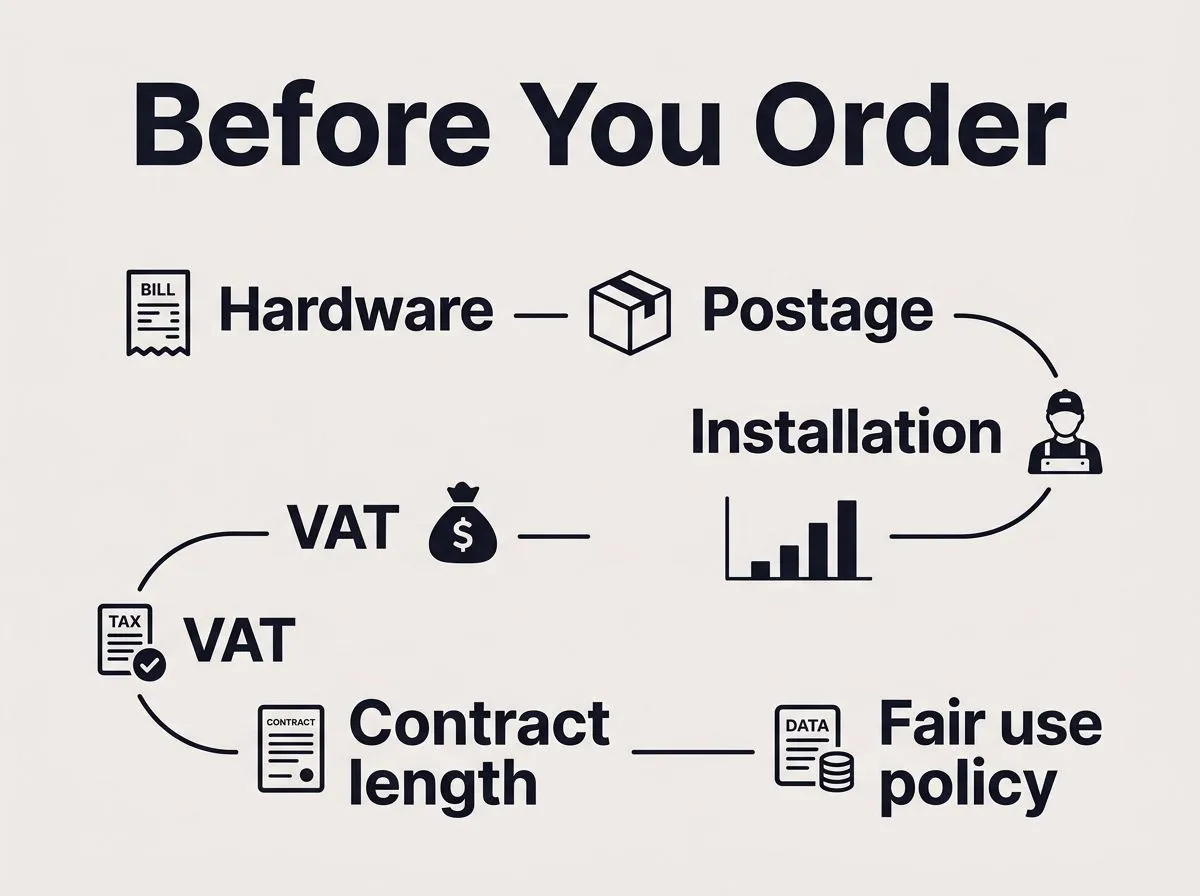
- The quote must show the full first payment, including hardware, postage, installation and VAT if it applies.
- The plan page must state the contract length and the fair use policy in the same offer.
- The provider’s live availability check must confirm service at your exact address, not just in your province or town.
- The cancellation terms must name the exit cost or notice period before you submit payment.
Frequently asked questions
How long does satellite internet installation usually take?
It can be as quick as 7 working days, though other published examples run to 7 to 14 working days depending on the provider and stock. That means the real delay is often not the satellite link itself, but getting the kit delivered and the install booked. Always confirm both windows before you order.
Does satellite internet need a clear view of the sky?
Yes. A clear view is essential because the dish has to maintain a clean line of sight to the satellite. Trees, chimneys and roof edges can all interfere, so if the dish cannot see the sky properly, performance suffers or the service may not work at all.
Can satellite internet be used for streaming and video calls?
Yes, but it depends on the package and the provider’s usage rules. A plan that is uncapped on paper may still be subject to fair use limits, so heavy streaming can slow down once you hit an internal threshold. Check the speed and the policy, not just the headline price.
Why do some satellite plans look expensive compared with fibre?
Because you are paying for more than monthly data. Satellite usually includes costly hardware, shipping or installation, and the article’s examples show upfront costs such as £529 for Starlink hardware plus £55 postage, or R999 and R2,500 setup charges on South African offers. It is priced for reach, not for the cheapest possible bill.