
What South Africans should know before buying a used EV
A used EV is only a bargain if the battery health, charging compatibility and paperwork all line up, because the cheapest listing can turn into the most expensive car on the forecourt. In South Africa, the safest buy is the one with a clear battery report, a service trail, the right connector for your charging plan and consumer protection you can actually use.
Key takeaways
- Ask for a battery state-of-health report and the service history before you negotiate, because the battery is the costliest risk.
- Check the connector and charging standard against your home or public charging plan, or the car may not suit your routine.
- Compare running costs against your actual tariff, not a generic estimate, then factor in tyres, insurance and specialist repairs.
- If a dealer sells the car, keep the invoice and disclosure forms, because the Consumer Protection Act can help if the vehicle was misrepresented.
What to check before buying a used EV
- Ask for any battery state-of-health report, and note whether the seller can show dealer paperwork rather than a vague verbal claim.
- Check the charging inlet and charging standard the car uses, then confirm it matches the equipment you plan to use at home or in public.
- Review the service history, remaining warranty cover and any evidence of accident, flood or fire damage.
- Compare the odometer reading with the car’s age, software update record and ownership pattern, because low use and poor storage can still hide problems.
How EV charging works at home and in public
| Use case | How it works in practice | Typical speed | What you need |
|---|---|---|---|
| Home charging | You plug into a dedicated charger or a suitable domestic setup overnight, which suits predictable daily mileage. | Slowest to moderate, depending on installation and car onboard charger. | A wallbox installation or approved home charging point, plus space and access to a safe electrical supply. |
| Workplace charging | The car tops up while you are parked for several hours, which helps if your daily commute is regular. | Usually slower than rapid public charging, but often enough for a meaningful daily top-up. | Access permission from the employer or building manager, plus any network app or card required by the site. |
| Public charging | You stop at a charging point on longer trips or while out and about, then pay or authenticate through the network. | Fastest when DC rapid charging is available, but not every car can take full advantage. | An account or app with the charging network, and a connector that matches the charger and the vehicle. |
What ownership can cost in South Africa
Electricity is usually the main running cost to compare with petrol or diesel, but the answer changes with the tariff you actually pay, so check your Eskom or municipal rate before you do any savings maths. That matters, because a vehicle that looks cheap per kilometre on paper can look far less impressive once you factor in your local tariff, your charging pattern and any peak-time usage.
Insurance can sit higher or lower depending on the model’s repair profile, replacement part availability and the insurer’s view of EV risk. Tyres still matter as a real cost item, and EVs can be hard on them because of weight and torque, so ask when the last set was fitted and what size the car takes before you assume the advertised price is the full story.
Maintenance is often lighter than on a petrol car, but that does not mean it is negligible. Brake fluid still needs changing, cabin filters still need replacement, and suspension, tyres and coolant circuits can still need attention. Specialist labour for high-voltage work may also cost more than an ordinary service bay visit.
If the car is imported, or the seller has structured the sale through a dealer chain, check the final invoice carefully for VAT, import-related charges and any admin fees that alter the on-the-road price. For current electricity tariffs, charging-network fees and any incentives, the buyer should verify the latest figures directly with the relevant municipality, Eskom or network operator before signing.
Which buyer protections apply to a second-hand EV
The Consumer Protection Act, 2008 applies when a dealer sells a used vehicle, which means the seller must be fair about disclosure and the vehicle must match what was represented at the point of sale. That protection is useful, but it is strongest when the buyer keeps the invoice, the disclosure forms and the pre-delivery inspection record, because those documents give you something concrete to point to if the car arrives with a hidden fault.
A dealer warranty, any remaining manufacturer warranty and the battery warranty are separate things, and you should read each one on its own terms. The battery cover is especially important on an EV, because a healthy car can still have a depleted or poorly supported high-voltage pack, and the repair bill on that part is the one most buyers are trying to avoid.
If the seller will not resolve a serious fault, the first formal step is usually to put the complaint in writing and keep proof of delivery. If that does not work, the National Consumer Commission is one of the bodies a buyer can approach, and it is worth naming the precise defect, the date of sale and the remedy sought rather than sending a vague complaint that is easy to ignore.
A practical pre-purchase checklist for South African buyers
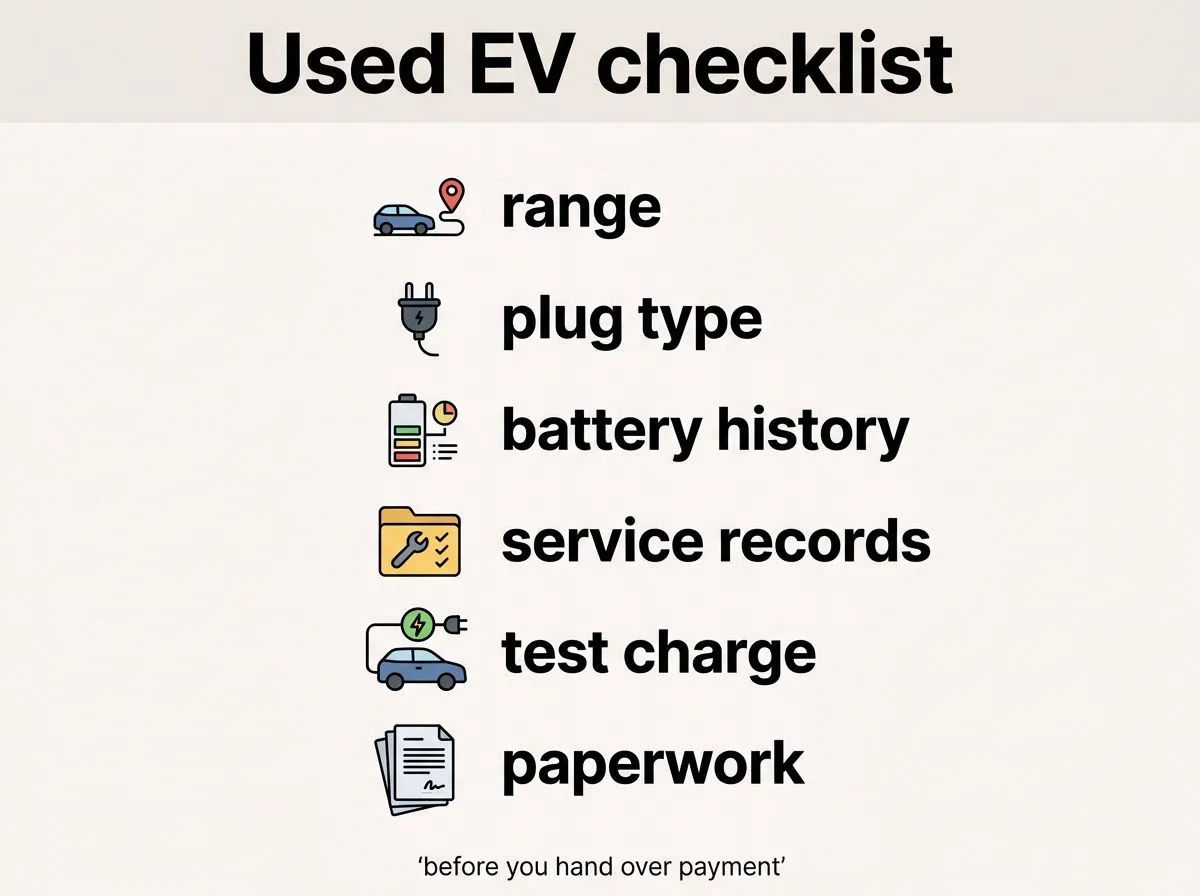
- Confirm the range you actually need for your daily driving before you look at the price.
- Test charging with the plug type you will use most often, not with the easiest possible setup.
- Ask for battery and service documentation before negotiating the price.
- Inspect the car with an independent mechanic or EV-capable specialist.
- Compare the total ownership cost with a similar petrol or hybrid alternative before you commit.
What this means in practice
A used EV is worth buying when the paperwork, charging setup and battery condition all point in the same direction. That is the real filter, not badge prestige or a bargain headline price. If the seller cannot prove what the battery is doing, cannot show service history, or cannot match the car to your charging life at home and on the road, walk away and keep looking.
Frequently asked questions
How can I tell whether a used EV battery still has useful life left?
Ask for a battery state-of-health report, then check whether the car’s real-world range is close to what the seller claims on a full charge. A healthy-looking odometer is not enough on its own, because poor storage or long periods of inactivity can still hide battery issues. If the seller cannot show dealer paperwork or a clear service trail, treat that as a warning sign.
Can I charge a used EV from a normal household plug in South Africa?
Sometimes, yes, but only as a slow emergency option rather than a proper day-to-day charging plan. If you expect to use the car regularly, a dedicated home charger or approved home charging point is the safer and more practical choice. The key is whether your electricity supply and the car’s onboard charger can handle your normal routine.
Do all used EVs use the same charger connector?
No, they do not. Compatibility depends on the model and on whether you are charging with AC or DC, so you need to check the car’s inlet type against the charging equipment you plan to use at home or in public. A car that looks like a bargain can still be awkward or expensive to live with if the connector does not match your charging setup.
What paperwork should I insist on from the seller?
At minimum, ask for the invoice, service history, ownership records, battery warranty details and a written disclosure of any known defects or accidents. If the car is imported or sold through a dealer chain, also check the final invoice for VAT, import-related charges and admin fees. Keep every document together, because they matter if you later need to make a consumer claim.