
What to check before signing up for a store card
A store card is only worth signing if the interest, fees and repayment rules still stack up once the till discount has disappeared. Check the total cost of credit, the minimum repayment, the statement and due dates, and whether the card can be used anywhere other than one retailer. If any of that is fuzzy, walk away and compare it with a credit card instead.
Key takeaways
- A small till discount is not enough if the balance stays open: interest and fees can push a R5,000 purchase above R6,100 over 24 months at 21%.
- Read the statement and due dates before you apply, because even one missed payment can trigger late fees and credit bureau damage.
- Pay more than the minimum repayment if you can, since the minimum is usually only about 3% to 5% of the balance and clears debt slowly.
- Check whether the card works only at one retailer, because limited use can make it easier to justify spending but harder to compare value.
- Look for initiation fees, monthly account charges and optional insurance in the contract, not just the advertised interest rate.
What a store card really costs
A store card ends up costing more than the sticker discount if you carry the balance for long enough, because interest, service fees and any add-ons keep ticking over after the purchase. In South Africa, store cards from retailers such as Edgars, Woolworths, Mr Price and Truworths are often quoted in the mid-teens to low twenties on a yearly basis, and Debt Solutions 4U gives the practical example of a R5,000 purchase at 21% interest costing more than R6,100 over 24 months.
That is the figure shoppers should focus on: the total cost, not the monthly instalment. A short-lived discount can disappear quickly if the account also carries initiation charges, a monthly service fee, late-payment charges, or optional insurance sold with the card. Read the agreement for the APR or annual interest rate, the initiation fee, the monthly account fee, the late fee and anything described as protection, cover or insurance.
Pay close attention to the wording around promotional offers too. If the discount only applies for a short opening period, or only on selected items, the card can look cheap at the till and turn expensive by the time the statement arrives. The real warning sign is not just a high rate, but a contract that keeps the expensive part running while the cheap part drops away fast, until the balance is cleared.
How repayments work
Repayments start with the statement date and the due date, and missing either one can lead to extra charges or reporting problems. Your statement date is when the bill is generated, and the due date is the last day you can pay without falling into arrears.
- Find the statement date on the monthly account statement or in the app, because that is when the balance used for that month is fixed.
- Check the due date next to the amount due, then pay before that date rather than on it, so bank processing delays do not leave you late.
- Look for the minimum repayment figure, because that is the least you can pay and still keep the account in good standing.
- If you cannot pay in full, pay more than the minimum. Paying only the minimum keeps the balance open longer and increases the interest you pay over time.
- After a part-payment, interest is charged on the remaining balance, so the debt reduces slowly unless the monthly payment is large enough to cut the capital.
- If you miss the payment date or pay too little, expect a late fee, possible collection action and a negative mark if the account is reported to a credit bureau.
A minimum repayment is usually a small percentage of the balance, and Old Mutual notes that this is commonly around 3% to 5% on credit products. It sounds manageable, but that is exactly why the debt can hang around: the payment is meant to keep the account current, not clear it quickly. If you keep rolling the balance, the card turns into a long-running cost rather than a short-term convenience.
How store cards differ from credit cards
| Feature | Store card | Credit card |
|---|---|---|
| Where it can usually be used | Often limited to one retailer or a shopping network linked to that issuer | Usually accepted more widely, including online and in many point-of-sale terminals |
| Rates and offers | Can carry store-account pricing and retailer promotions, with a narrow focus on in-store deals | Usually has broader payment flexibility and may include travel or cash-like features depending on the issuer |
| Control and pressure | Can help you limit spending to one chain, but that also makes the card easier to justify at checkout | Gives more freedom, but that freedom can make overspending easier if you do not track the balance |
| Best fit | A shopper who buys regularly from one chain and clears the balance quickly | A shopper who wants wider acceptance and pays in full or nearly in full each month |
A store card can feel cheaper at the till because the offer is tied to one retailer, but that narrow use can become expensive if you keep using it for non-essential purchases. A credit card usually gives you more flexibility, while a store card gives the retailer more control over where and how you spend. The better choice is the one that fits your spending pattern, not the one with the loudest signboard offer.
The key terms to read before you apply
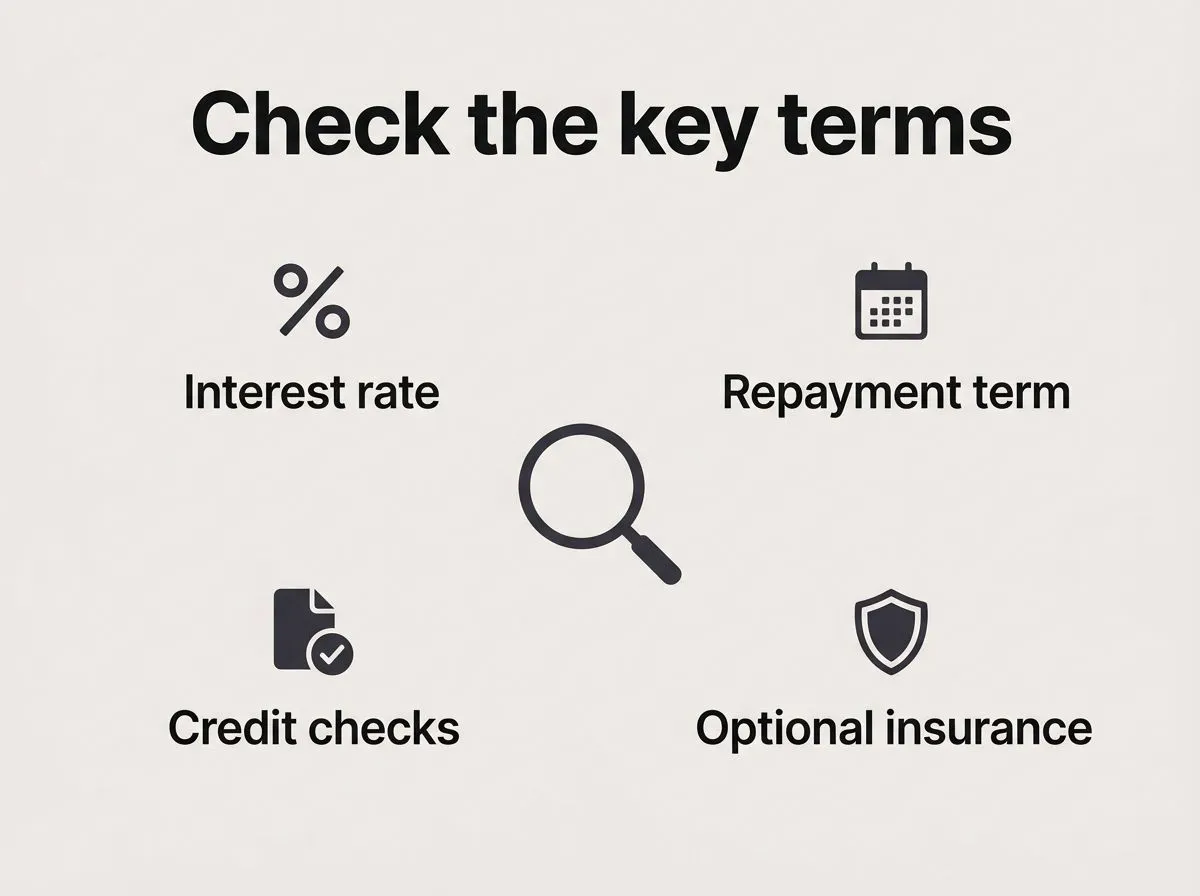
- Affordability and credit checks, because approval does not mean the account is affordable for your budget.
- Interest rate, repayment term and whether the first purchase gets an interest-free period, because that changes the real cost of borrowing.
- Fees, insurance and other account charges, because a small monthly add-on becomes a real cost over a year.
- Promotional offers and discount conditions, because the offer can end before you have finished repaying.
- Credit limit wording and variation clauses, because the issuer may have rules that let it change terms or manage your limit.
Look for the exact name of the fee and the rule that triggers it. If the contract says the card includes optional insurance, check whether it is truly optional or already pre-selected at sign-up, because bundled add-ons are one of the easiest ways for the monthly bill to creep up without the shopper noticing.
Also check whether the card is a straight store account or linked to a wider network such as the RCS Store Card. RCS says its store card can be used at over 100,000 stores and offers up to 55 days interest-free, which shows why the exact product matters. One card can behave like a narrow shop account, while another sits much closer to a broader retail credit facility.
Your rights if something goes wrong
Your strongest protection is disclosure, fair treatment and the right to challenge wrong information under the National Credit Act. In plain English, that means the card issuer has to tell you the cost and the terms clearly, and it must treat the account according to the agreement rather than changing the rules quietly after you sign.
If the account is reported incorrectly, dispute it with the credit bureau straight away and keep copies of every letter, email and statement. Ask the store first, because most billing errors start with the issuer’s records, but do not wait if the problem affects your credit file. A paper trail matters, because a phone call leaves almost nothing you can prove later.
If the store does not sort out the matter, escalate it to the National Credit Regulator. Use the complaints route in the store’s own terms first, then go to the regulator with the account number, the statement, the date you complained and the response you received. That is the cleanest way to show that you tried to fix the problem before asking for outside help.
The practical test is simple: sign only if you can clear the balance within the period that keeps interest and fees under control, and only if the contract names every cost in plain language. If the offer depends on a discount, treat the discount as a bonus, not the reason to borrow.
Frequently asked questions
Can a store card charge interest straight away?
Yes. Some store cards start charging interest from the purchase date, while others only give relief if you meet a promotional condition, such as clearing the balance within the offer period. The key is the agreement: it should state the APR or annual interest rate, when the charge starts, and whether the first purchase gets an interest-free period.
What should I do if the store changes my credit limit or terms after approval?
Check the contract first, because variation clauses may let the issuer change a limit or other terms within the rules you agreed to. If the change seems wrong, ask for the new terms in writing and use the store’s complaints process before escalating further. Keep the agreement, the statement and the response, because that paper trail matters if you need to challenge it.
Will applying for a store card affect my credit record?
Usually yes, because approval normally involves a credit and affordability check. If the application is declined, or if you later miss payments, that can also affect your credit file. The practical point is that the application itself may leave a footprint, so it is worth checking you can afford the account before you apply.
Are store card rewards worth it if I pay the balance in full?
They can be, but only if the discount or benefit is greater than any initiation fee, monthly account fee or add-on cost. Even if you pay in full each month, a short promotional offer can disappear before the account has finished costing you. If the rewards are tied to one retailer and the card has wider fees, the maths can still favour a plain credit card or no card at all.