Which South African banks offer the best fixed deposit rates?
Which South African banks offer the best fixed deposit rates? In the material provided, the strongest published offers come from African Bank and GoTyme Bank, with Investec serving as backdrop for how term, balance and the way interest is credited can change the result. The best choice still comes down to how long you can lock the money away, how much you are putting in, and whether you might need early access.
Key takeaways
- African Bank’s published top band reaches 7.17% effective on deposits above R1 million.
- GoTyme Bank shows a 12-month example of R10,000 growing to R10,875 at 8.75%.
- South Africa’s deposit interest rate was 6.83% in July 2026, so offers above that are competitive.
- A higher balance band can lift your return without changing the product type, so a small top-up may matter.
- Early withdrawal can reduce the payout, so only lock money away if you can leave it untouched until maturity.
How fixed deposits work in South Africa
A fixed deposit is money you place with a bank for a set term at a fixed interest rate, and the bank usually keeps it locked until maturity. If the product allows early withdrawal, the bank may apply a penalty or cut the interest paid, so the headline rate is only part of the decision.
Longer terms usually pay more because the bank is paying for the loss of access, while instant-access savings and notice accounts are different products and should not be treated as the same thing.
The practical test is straightforward: if you might need the cash before the term ends, a fixed deposit only makes sense when the provider’s early-exit rules are acceptable. If the money has to stay accessible, a notice account or flexible savings account belongs in the comparison instead.
Best fixed deposit rates by term and deposit size
| Provider | Term | Deposit amount band | Nominal annual interest rate | Annual effective rate | Short note or example |
|---|---|---|---|---|---|
| African Bank | Fixed deposit, latest published banded rates | R0 to R49,999.99 | 6.51% | 6.93% | Lower band on the product page |
| African Bank | Fixed deposit, latest published banded rates | R50,000 to R249,999.99 | 6.60% | 7.02% | Rate steps up once the balance reaches the next band |
| African Bank | Fixed deposit, latest published banded rates | R250,000 to R999,999.99 | 6.70% | 7.02% | Same effective rate as the middle band in the published table |
| African Bank | Fixed deposit, latest published banded rates | More than R1,000,000 | 6.79% | 7.17% | Highest published band in the source provided |
| GoTyme Bank | Fixed deposit, term selectable from 3 to 36 months | No balance band stated in the source provided | Not separately listed in the source excerpt | Not separately listed in the source excerpt | Example given: R10,000 for 12 months at 8.75% returns R10,875 at maturity |
| Investec | Fixed-term deposits, term and structure focus | Not stated in the source provided | Not stated in the source provided | Not stated in the source provided | Useful mainly as a reminder that longer lock-ins are designed to improve returns |
| South African market context | Deposit rates, July 2026 | N/A | N/A | 6.83% average deposit interest rate in July 2026 | Trading Economics shows the market backdrop, not a bank offer |
African Bank’s published banded rates are the clearest rate table in the evidence, and the top band reaches 7.17% effective once the deposit goes above R1 million.
GoTyme’s product page is stronger on term flexibility, with a range from 3 to 36 months and an example of R10,000 growing to R10,875 over 12 months at 8.75%, which is a handy anchor if you are comparing a simple one-year lock-in.
For a market backdrop, Trading Economics shows South Africa’s deposit interest rate at 6.83% in July 2026, so offers above that level are competitive rather than run-of-the-mill.
The important point is that the same bank can price different balances differently, and a higher balance band can improve the return without changing the product type. That matters most if you are placing a lump sum, because moving into the next band can make a noticeable difference to the final payout.
Interest is paid differently depending on the account
Interest can be credited monthly, at maturity, or through compounding, and that changes the total return even when the headline rate looks similar. Nominal annual interest is the stated yearly rate, while annual effective rate is the return after compounding has been taken into account, so it is the better figure for comparing products that credit interest differently.
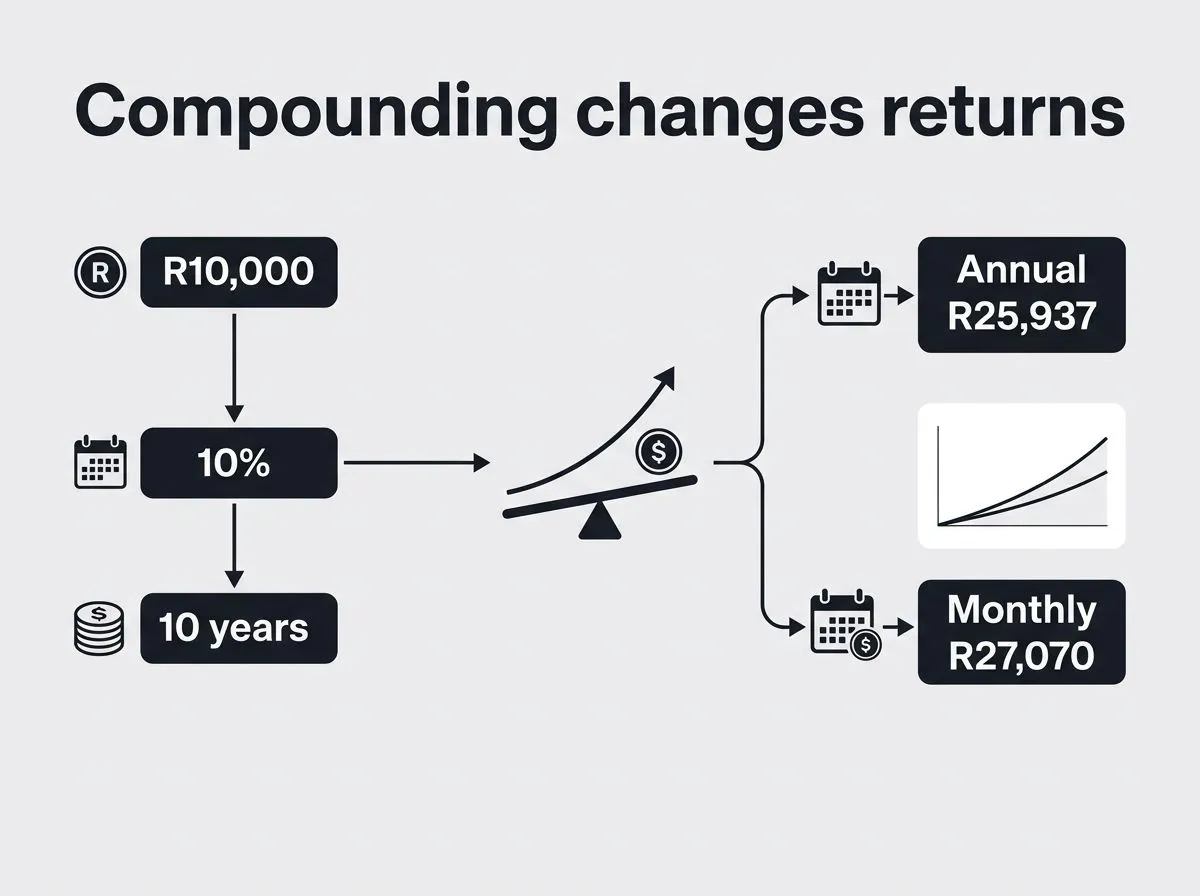
Accounter’s compound-interest calculator shows why frequency matters: R10,000 at 10% grows to R25,937 with annual compounding over 10 years, but to R27,070 with monthly compounding over the same period. The practical lesson is simple, more frequent crediting gives the interest itself more time to earn interest, so a product that pays more often can beat a slightly higher nominal rate that is credited less often.
For that reason, compare like with like. If one bank quotes a nominal rate and another shows an effective rate, convert them to the same measure before you choose, otherwise you may end up picking the weaker return by accident.
Minimum deposits, access restrictions and early withdrawal conditions
- Minimum deposits vary by bank and by product, and some published rate bands only apply once you reach a specific balance.
- The rate can change when the deposit moves into another band, so a small top-up can matter.
- Some fixed deposits allow early withdrawal, but the bank may apply a penalty or cut the interest paid.
- The safest rule is to lock away only money you can genuinely leave untouched for the full term.
- Access rules matter as much as rate, because a slightly higher return is useless if you need the cash sooner.
GoTyme’s product page makes the practical point clearly: you choose the term from 3 up to 36 months, and you can open one fixed deposit or several, which suits savers who want to split cash across different time horizons. GoTyme’s companion article also says early withdrawal may attract a penalty, so the higher rate only rewards patience if you can leave the term alone.
Tax on fixed deposit interest in South Africa
Interest earned on fixed deposits is subject to South African tax rules, so the rate you see is not the same as the money you keep after tax. That matters more on larger deposits and longer terms, because the interest can become material over time.
Before you commit funds, check the current interest exemption thresholds and filing guidance from the South African Revenue Service, because the take-home return depends on your tax position. The published bank rate tells you the gross return; SARS tells you what part of that return may be taxable.
Where to check the latest published rates before opening an account
- Start with the bank’s own product page, because that is where the live rate table, term bands and any balance bands are usually published. Use African Bank fixed deposit product page and GoTyme fixed deposit product page as the model of what to look for.
- Read the product terms carefully to confirm the minimum deposit, early withdrawal rules and whether interest is paid monthly, at maturity or by compounding.
- Check whether the quote shows a nominal annual rate, an annual effective rate, or both, then compare the same measure across providers so you are not comparing unlike figures.
- Use an independent rate tracker or calculator as a cross-check, such as Trading Economics for market context or Accounter compound interest calculator for return estimates, but treat the bank’s own published terms as the final reference before applying.
What to choose if you are rate-led
A one-year fixed deposit makes the most sense when you want a clean, predictable outcome and can leave the money untouched for 12 months. In the material provided, GoTyme’s 12-month example at 8.75% produces a simple end balance, while African Bank’s top published band reaches 7.17% effective for balances above R1 million, which is the stronger published rate table for larger lump sums.
If your priority is the highest visible rate on a medium or larger balance, African Bank’s published bands are the most useful starting point. If your priority is term flexibility, GoTyme is easier to fit around a known timeline because the term range runs from 3 to 36 months.
Verification checklist
- Open the bank’s live product page and confirm the quoted rate is still current, with the acceptance criterion that the same rate appears on the provider page on the day you apply.
- Check the minimum deposit and balance band, with the acceptance criterion that your planned deposit falls inside the exact band shown on the product page.
- Read the early-withdrawal rule, with the acceptance criterion that you can point to the penalty or reduced-interest clause before transferring funds.
- Compare the rate type, with the acceptance criterion that you have matched nominal to nominal or effective to effective before making your shortlist.
Frequently asked questions
Do fixed deposit rates change after I open the account?
No, the rate is normally fixed for the term you agreed when you opened it, which is the whole point of a fixed deposit. The main exception is an early withdrawal, where the bank may reduce the interest or apply a penalty instead of changing the agreed rate mid-term.
Can I add more money to an existing fixed deposit?
Usually not once the deposit is opened. Most providers treat each fixed deposit as a separate contract, so if you want to place more funds, you normally open a new one. That also means a top-up can move you into a different balance band and change the rate available on the new deposit.
Is a fixed deposit better than a notice account?
A fixed deposit usually pays more, but a notice account gives you more flexibility if you may need the cash early. If you can leave the money untouched until maturity, the fixed deposit is usually the stronger rate choice; if access matters more, the notice account is the safer fit.
How do I compare two fixed deposit offers fairly?
Compare the same term, the same deposit band and the same type of interest figure, then look at the annual effective return rather than the headline rate alone. That matters because one bank may credit interest monthly or at maturity, and the payout can differ even when the advertised rate looks close.